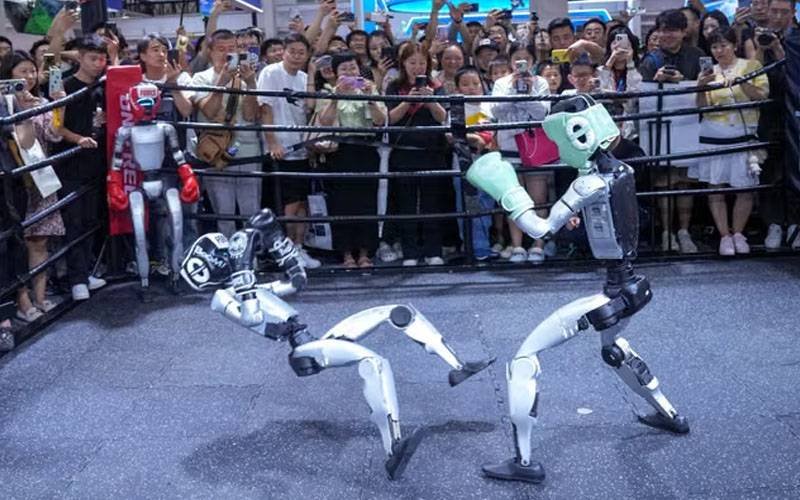
According to organisers, 666 teams from 16 countries will participate in this year’s event with a total of 2,056 humanoid robots. The number of participating robots has increased nearly fourfold compared with last year’s inaugural competition.
Teams from major robotics hubs including the United States, Germany and Japan will take part, while Brazil is also sending a national contingent comprising five RoboCup teams.
China will have the largest representation, with 641 teams and 1,975 robots, including entries from 157 companies, 200 universities and research institutions, and 27 leading Chinese universities.
More than 30 competitions will be held this year, with new events including long jump, weightlifting, tug-of-war and table tennis. The contests are designed to test robots’ movement control, physical capabilities and hardware performance.
The event will also go beyond traditional sports, with humanoid robots required to perform practical tasks in simulated factories, hotels, homes and logistics centres. These challenges will include assembling objects, household cleaning, responding to emergencies and organising books in a library.
Organisers say the aim is to assess how effectively humanoid robots can handle increasingly complex tasks in real-world environments.
Jiang Guangzhi, director of the Beijing Municipal Bureau of Economy and Information Technology, said rules developed during the competitions could eventually contribute to technical standards for the robotics industry.
The organisers also envision competition results translating into commercial opportunities, with successful robots potentially attracting business orders and employment opportunities as they become capable of performing complex everyday tasks.
The first World Humanoid Robot Games were held in Beijing in August 2025, featuring more than 500 humanoid robots representing 280 teams from 16 countries.