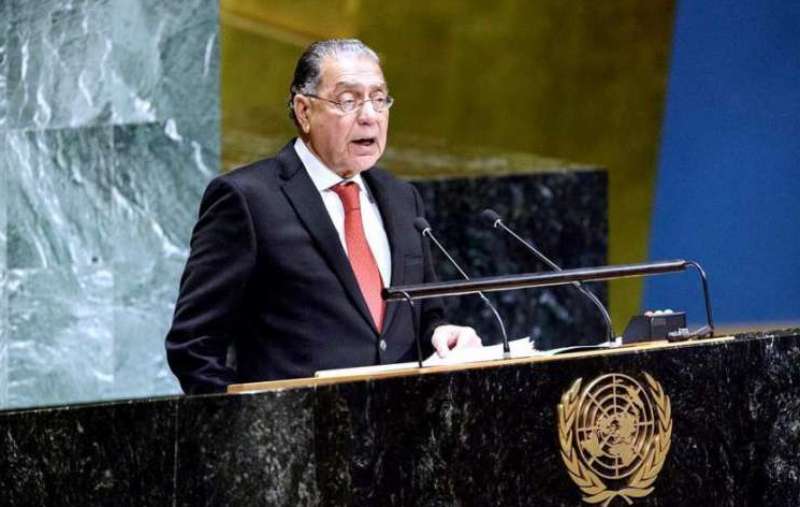
UNITED NATIONS: Pakistan, which firmly opposes additional permanent members on the UN Security Council, has reaffirmed it call for equitable representation of regional groups on the 15-member body by adding more non-permanent seats to it.
“The regional distribution of 11-12 non-permanent seats proposed by the UfC (Uniting for Consensus group led by Italy and Pakistan) would ensure ‘equitable representation’ of each region,” Ambassador Munir Akram said as the long-running Inter-Governmental Negotiations (IGN)Baimed at reforming the 15-member Council resumed the process on Tuesday.
“The reform of the Security Council should redress the existing imbalances in the regional representation – adding to the representation of the under-represented regions and at least not adding to the representation of the over-represented regions,” the Pakistani envoy said.
“The UfC’s proposal – to add only non-permanent members, which are elected periodically by the General Assembly – is also more democratic,” he said, adding that it was fundamentally different from that of Group of four — India, Brazil, Germany and Japan — whose members claim permanent seats as a matter of right – a right borne out of a sense of self-entitlement. He described the G-4 claim as contrary to not only the UN Charter’s precept of the sovereign equality of member states, but also “undemocratic”.
About references made to the “new realities” during the debate on Tuesday and the claims by some to be in the Security Council because they have greater “capacity” and willingness to contribute to international peace and security, Ambassador Akram said the contributions of small and medium states have been much more sizable than the “self-interested positions and policies of those ambitious to achieve permanent membership”.
He also said, “Any state which stands in violation of the resolutions of the Security Council for over 50 years does not deserve to even claim the right to any membership on the Council.” Full-scale negotiations to reform the Security Council began in the General Assembly in February 2009 on five key areas — the categories of membership, the question of veto, regional representation, size of an enlarged Security Council, and working methods of the council and its relationship with the General Assembly.
Despite a general agreement on enlarging the Council, as part of the UN reform process, member states remain divided over the details. The Security Council is currently composed of five permanent members — Britain, China, France, Russia and the United States — and 10 non-permanent members elected to serve for two years.
In his well-reasoned remarks, Ambassador Akram said while the existence of permanent members and the veto was the underlying cause of the Security Council’s paralysis, the addition of members in the permanent category would reduce the number of seats available to the rest of the UN’s membership.
“If 6 new permanent members are added, as has been proposed, this would leave only 4/5 additional seats for the rest of 182 members of the UN General Assembly from all 5 regions,” he said. “This would certainly not amount to the ‘equitable geographical representation’ prescribed in the title of the item under which we are exploring a reform of the Security Council.”
The UfC, he said, was sensitive to and supportive of Africa’s legitimate quest to rectify the “historic injustice” against the continent, which has no permanent seat on the Security Council. “This must be redressed as similar historic injustices against the Arab group, the OIC countries, the SIDS (Small Island Developing States), and Latin America.
Africa’s desire for ‘equal rights’ is very different from the individual claims to permanent membership of the four countries — the continent’s demand is for the region, not for individual states, Ambassador Akram said.
As an OIC member, the Pakistani envoy said that several Islamic Summit meetings have declared clearly that if there is an expansion of the Security Council, the Islamic countries must be represented in any category of membership that is created.
“We believe that the UfC’s proposal regarding ‘regional representation’ can provide a way to redress the historic injustices against Africa, the OIC, the Arab States, the SIDs and other regions. The UfC’s approach would ensure not only approval of the reform proposal by the General Assembly, it would also ensure the adoption of any Charter amendment required to reform the Security Council,” he said in conclusion.