Fast-forming alien planet has astronomers intrigued
By News Desk · Published November 22, 2024
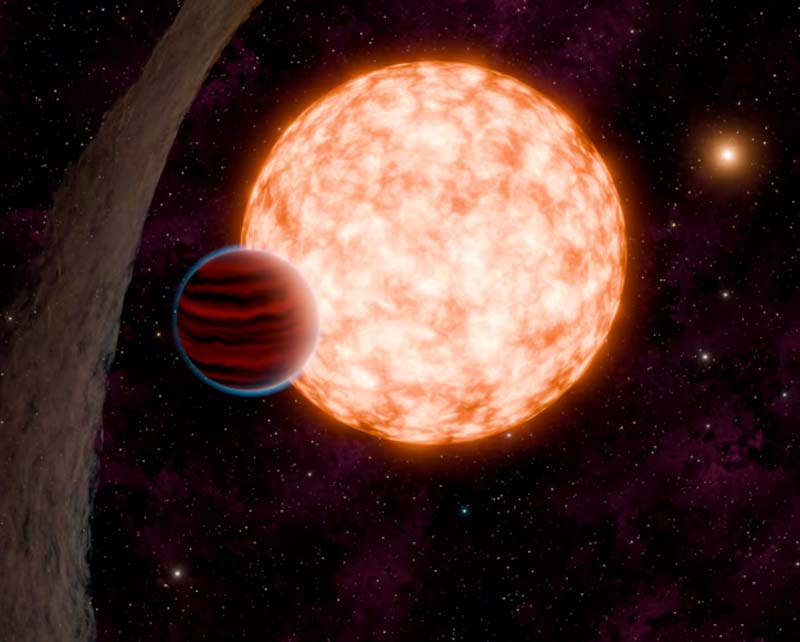
WASHINGTON, Nov 22 (Reuters): Astronomers have spotted orbiting around a young star a newborn planet that took only 3 million years to form – quite swift in cosmic terms – in a discovery that challenges the current understanding of the speed of planetary formation.
This infant world, estimated at around 10 to 20 times the mass of Earth, is one of the youngest planets beyond our solar system – called exoplanets – ever discovered. It resides alongside the remnants of the disk of dense gas and dust circling the host star – called a protoplanetary disk – that provided the ingredients for the planet to form.
The star it orbits is expected to become a stellar type called an orange dwarf, less hot and less massive than our sun. The star’s mass is about 70% that of the sun and it is about half as luminous. It is located in our Milky Way galaxy about 520 light-years from Earth. A light-year is the distance light travels in a year, 5.9 trillion miles (9.5 trillion km).
“This discovery confirms that planets can be in a cohesive form within 3 million years, which was previously unclear as Earth took 10 to 20 million years to form,” said Madyson Barber, a graduate student in the department of physics and astronomy at the University of North Carolina at Chapel Hill and lead author of the study published this week in the journal Nature.
“We don’t really know how long it takes for planets to form,” UNC astrophysicist and study co-author Andrew Mann added. “We know that giant planets must form faster than their disk dissipates because they need a lot of gas from the disk. But disks take 5 to 10 million years to dissipate. So do planets form in 1 million years? 5? 10?”
The planet, given the names IRAS 04125+2902 b and TIDYE-1b, orbits its star every 8.8 days at a distance about one-fifth that separating our solar system’s innermost planet Mercury from the sun. Its mass is in between that of Earth, the largest of our solar system’s rocky planets, and Neptune, the smallest of the gas planets. It is less dense than Earth and has a diameter about 11 times greater. Its chemical composition is not known.
The researchers suspect that the planet formed further away from its star and then migrated inward.
“Forming large planets close to the star is difficult because the protoplanetary disk dissipates away from closest to the star the fastest, meaning there’s not enough material to form a large planet that close that quickly,” Barber said.
The researchers detected it using what is called the “transit” method, observing a dip in the host star’s brightness when the planet passes in front of it, from the perspective of a viewer on Earth. It was found by NASA’s Transiting Exoplanet Survey Satellite, or TESS, space telescope.
“This is the youngest-known transiting planet. It is on par with the youngest planets known,” Barber said.
Exoplanets not detected using this method sometimes are directly imaged using telescopes. But these typically are massive ones, around 10 times greater than our solar system’s largest planet Jupiter.
Stars and planets form from clouds of interstellar gas and dust.
“To form a star-planet system, the cloud of gas and dust will collapse and spin into a flat environment, with the star at the center and the disk surrounding it. Planets will form in that disk. The disk will then dissipate starting from the inner region near the star,” Barber said.
“It was previously thought that we wouldn’t be able to find a transiting planet this young because the disk would be in the way. But for some reason that we aren’t sure of, the outer disk is warped, leaving a perfect window to the star and allowing us to detect the transit,” Barber added.