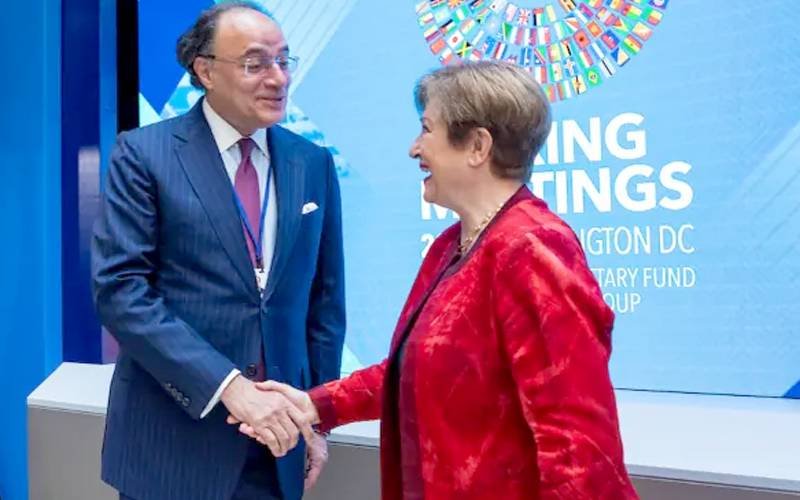
The meeting focused on Pakistan’s economic situation and progress on its reform agenda, according to 24 News HD.
Aurangzeb informed the IMF chief that Pakistan had reached a staff-level agreement with the Fund and was continuing to implement economic reforms across various sectors, including energy and taxation.
He briefed Georgieva on progress under the latest staff-level agreement and reaffirmed the government’s commitment to implementing the agreed reform measures.
Georgieva emphasised the importance of sustaining economic reforms to strengthen Pakistan’s economic stability.
The meeting came after the IMF released its World Economic Outlook 2026, which projected moderate economic growth and rising inflation in Pakistan.
According to the report, Pakistan’s economy is expected to grow by 3.6 per cent in fiscal year 2026, slowing slightly to 3.5 per cent in fiscal year 2027.
Inflation is projected to reach 7.1 per cent in 2026 before rising to 9.9 per cent in 2027.
The IMF also forecast Pakistan’s unemployment rate at 6.9 per cent in 2026, with a decline to 6.5 per cent in the following fiscal year.
Pakistan’s current account deficit is projected to stand at around one per cent of gross domestic product (GDP) in fiscal year 2027.
The IMF projected global economic growth to slow to 3.1 per cent in 2026 before recovering to 3.4 per cent in 2027.
Global inflation is expected to rise to 4.7 per cent in 2026 and then ease to 4.1 per cent in 2027.
The report noted that technological advances and the ability of economies to adapt to changing conditions had helped cushion the impact of various global shocks.
Pakistan’s continued implementation of reforms, particularly in energy and taxation, remains central to its efforts to strengthen economic stability and sustain growth.