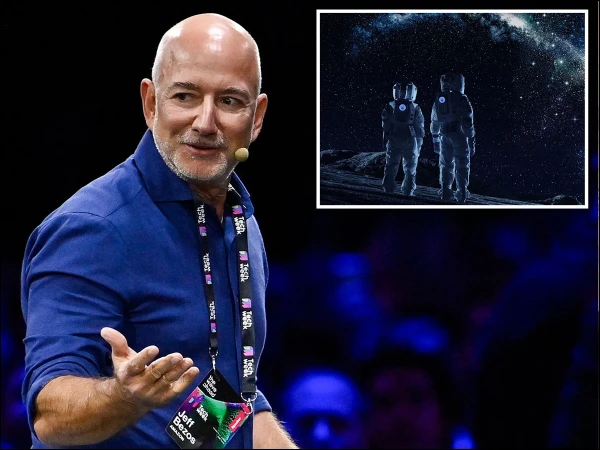
Speaking at Italy’s Tech Week, Bezos said technological progress over the next two decades could allow millions of people to settle in space.
He believes most will choose to live there out of personal interest rather than because human presence is essential.
Bezos also suggested that robots could perform difficult tasks on the Moon and other planetary bodies more efficiently and at a lower cost than sending humans.
Addressing concerns that artificial intelligence could eliminate jobs and threaten the future of human civilisation, Bezos argued that inventions generally improve society’s prosperity. He compared modern technological advances with historical innovations, such as the plough, which helped improve human life thousands of years ago.
Other technology leaders have also expressed optimism about humanity’s future in space. OpenAI chief executive Sam Altman has predicted that university graduates could find exciting, well-paid jobs in the space industry within the next decade.
Meanwhile, Tesla and SpaceX chief executive Elon Musk has supported plans to send humans to Mars, suggesting that crewed missions could become possible in the coming years.
Voyager Technologies chief executive Dylan Taylor has also said that living and working in space is no longer simply a distant dream, with early progress potentially emerging in the 2030s.
However, large-scale, permanent human settlements beyond Earth still face major challenges, including technological limitations, high costs and the practical difficulties of sustaining human life in space.