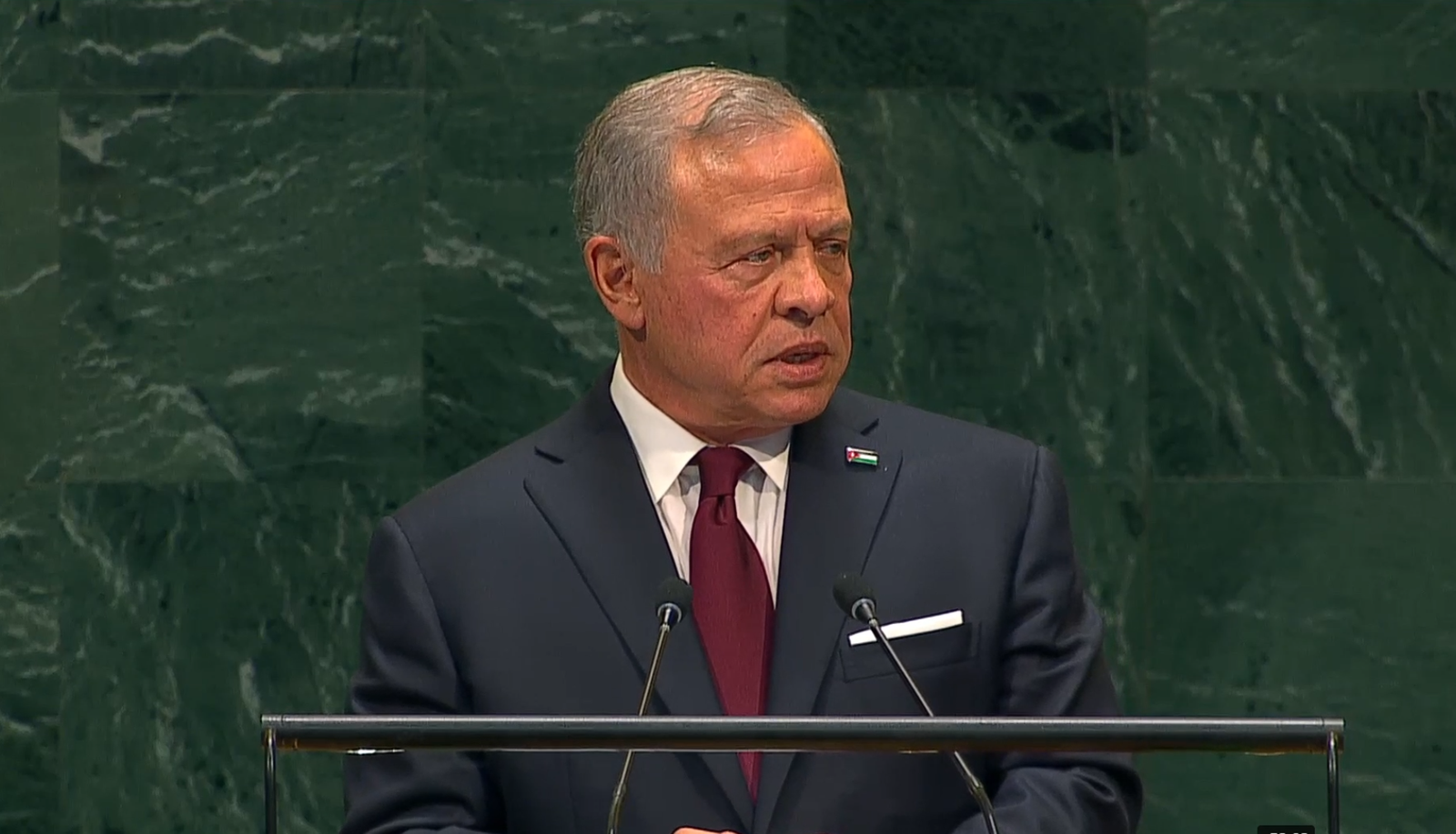
Addressing the United Nations General Assembly, Jordan’s King Abdullah II highlighted that the humanitarian tragedies in Gaza and the accelerating displacement and violence in the West Bank are part of a single, systemic policy that threatens the foundational possibility of a viable Palestinian state.
King Abdullah II warned the UN that global attention is becoming increasingly fragmented. He said this threatens sustained international action on conflicts, humanitarian crises and violations of international law.
“Attention has become a scarce asset,” Abdullah said.
He argued that where governments direct their attention increasingly determines which crises receive sustained diplomatic action. He said the international community often reacts to emergencies while neglecting warning signs behind them.
Gaza and the West Bank
King Abdullah said prolonged conflicts across the Middle East are deepening humanitarian suffering. He cited Lebanon, Yemen and Sudan among the region’s continuing crises. He also warned that instability can affect people far beyond conflict zones.
“The war has shown how quickly instability can disrupt trade, investment, and lives beyond the region,” he said. Abdullah then focused on Gaza and the Palestinian-Israeli conflict. He said he had repeatedly warned the UN about the consequences of leaving the conflict unresolved.
“The international community chose to manage the conflict, not confront it,” Abdullah said. He argued that repeated violations had gradually turned temporary conditions into permanent realities.
Gaza Humanitarian Crisis
Abdullah said the international community must confront what he described as the consequences of continued Israeli military action. “In Gaza, the evidence is overwhelming,” he said. He claimed that at least 300 Palestinian children had been killed during the first 300 days of the so-called ceasefire.
He also said Jordanian field hospitals had been targeted. Abdullah credited President Donald Trump with pushing for peace and an end to the war. But he accused the Israeli government of continuing attacks and destroying civilian infrastructure.
He also accused Israel of refusing to withdraw and restricting Palestinians to a small portion of Gaza.
“This can no longer be dismissed as temporary military measures or a consequence of war,” Abdullah said. He called for accountability and argued that Palestinian life and Gaza’s territorial future were at stake.
West Bank Displacement
Abdullah said developments in the West Bank represented a major change rather than another escalation. He described settler violence as widespread and accused Palestinians of facing beatings, shootings and intimidation.
He also cited home demolitions, property destruction and the displacement of families. “It is time to see what is happening for what it is,” Abdullah said. He argued that language should not sanitize actions or make them appear normal.
Abdullah described demolitions linked to settlement expansion as forced transfer. He described the appropriation of occupied land as de facto annexation. He also characterized checkpoints and barriers as a system of subjugation.
“What is unfolding across the West Bank is not a series of isolated acts,” he said. Abdullah argued that the developments formed part of a policy aimed at compelling Palestinians to leave their land. “There is a name for that: forced displacement. And that is a war crime,” he said.
Two-State Solution
Abdullah said Gaza and the West Bank must be viewed as parts of the same conflict. “Gaza and the West Bank are not separate stories,” he said. He argued that both territories were experiencing changes intended to make Palestinian statehood increasingly difficult.
Abdullah said Gaza was being transformed through destruction while the West Bank faced what he called de facto annexation. He also rejected the idea that Israel’s current rejection of Palestinian statehood might simply change. “That position is cemented on the ground,” he said.
Abdullah pointed to settlement expansion since the Oslo process as evidence of changing conditions. He also rejected the argument that Arab countries had never offered Israel a path toward peace.
He cited the 2002 Arab Peace Initiative. “The Arab Peace Initiative of 2002 offered Israel normalization with 57 Arab and Muslim states,” Abdullah said.
He said the initiative offered normalization in exchange for peace and Palestinian statehood. “For over 20 years, that offer has stood,” he said.
Abdullah argued that the obstacle was not an absence of a potential peace partner. He said the problem was the absence of an Israeli government willing to accept the proposal.
RELATED: Eight Muslim Countries Voice Concern Over Humanitarian Crisis in Gaza
International Action
Abdullah said the international community has tools available to respond to violations. He cited sanctions, asset freezes, embargoes and diplomatic isolation. “We have tools,” he said, arguing that governments have used similar measures in other situations. He criticized the gap between international resolutions and enforcement.
“With Israel, resolutions end where they began: on paper,” Abdullah said. He warned that continued impunity could encourage further actions beyond the Palestinian territories. Abdullah also raised concerns about developments in Syria.
“Today, Syria is the warning the international community is choosing not to see,” he said. He cited repeated incursions, territorial expansion and developments involving vital water resources. He warned that continued international inaction could encourage further challenges to borders and international law.
Jordan’s Security
Abdullah said Jordan views threats to its northern border and water security as national-security issues. “For Jordan, there is no ambiguity, any threat to our northern border or our water security is a threat to our national security,” Abdullah said.
He said Jordan would protect its security, water resources and national interests. He also questioned whether the international community would respond to continued developments in southern Syria.
Jordan’s Diplomatic Role
Abdullah said Jordan was pursuing diplomacy while responding to regional security and humanitarian challenges. He described Jordan as a regional hub connecting the Gulf with the Mediterranean. He said the country was developing trade, industry and technology links while responding to humanitarian crises.
He also said Jordan was confronting terrorism and strengthening its defenses. Abdullah highlighted Jordan’s efforts against threats including narcotics trafficking. He said Jordan would continue protecting Christian communities and heritage in the region.
He also pledged efforts to promote what he described as the true image of Islam against extremist voices. Jordan, he said, would continue supporting Palestinian resilience and UNRWA. He also reaffirmed Jordan’s commitment to the Hashemite custodianship and historic status quo at Jerusalem’s Muslim and Christian holy sites.
Diplomacy and International Law
Abdullah said Jordan wanted to provide a stable model during a period of international uncertainty. He described his country as committed to principles, diplomacy and cooperation. “A country the world can count on true to our principles, true to our word,” he said.
He stressed that Jordan’s preference for diplomacy should not be interpreted as weakness.“Our bias towards diplomacy will never supersede our commitment to human values,” Abdullah said. He also warned against relying on military force to solve global challenges.
“Military force cannot deliver meaningful solutions,” he said. Abdullah argued that lasting solutions require legitimate and trusted international institutions. He said those institutions must maintain trust between nations and enforce international agreements.
“Destroy that trust, and every challenge becomes harder,” he said. “Preserve it, and cooperation becomes possible,” Abdullah added. He concluded by warning that the world must remain attentive to crises even after public attention shifts elsewhere.
“The future is shaped not only by what we do, but what we choose to ignore,” Abdullah said.