
A new set of Republican-backed immigration bills would significantly reshape legal immigration if Congress enacted them.
But the proposals have already become easy to confuse.
Rep. Barry Moore introduced the Americans First Immigration Act, H.R. 8586, in April. Sen. Tommy Tuberville later introduced the ASSIMILATION Act, S. 4546, in May. Both bills would make major changes to legal immigration, but they are not identical.
Neither bill is currently law.
Both measures remain legislation introduced in Congress. H.R. 8586 was referred to House committees, while S. 4546 was referred to the Senate Judiciary Committee.
That distinction matters for immigrants with pending petitions, green-card applications or future visa plans.
What Would the Americans First Immigration Act Change?
H.R. 8586 would overhaul several legal immigration categories.
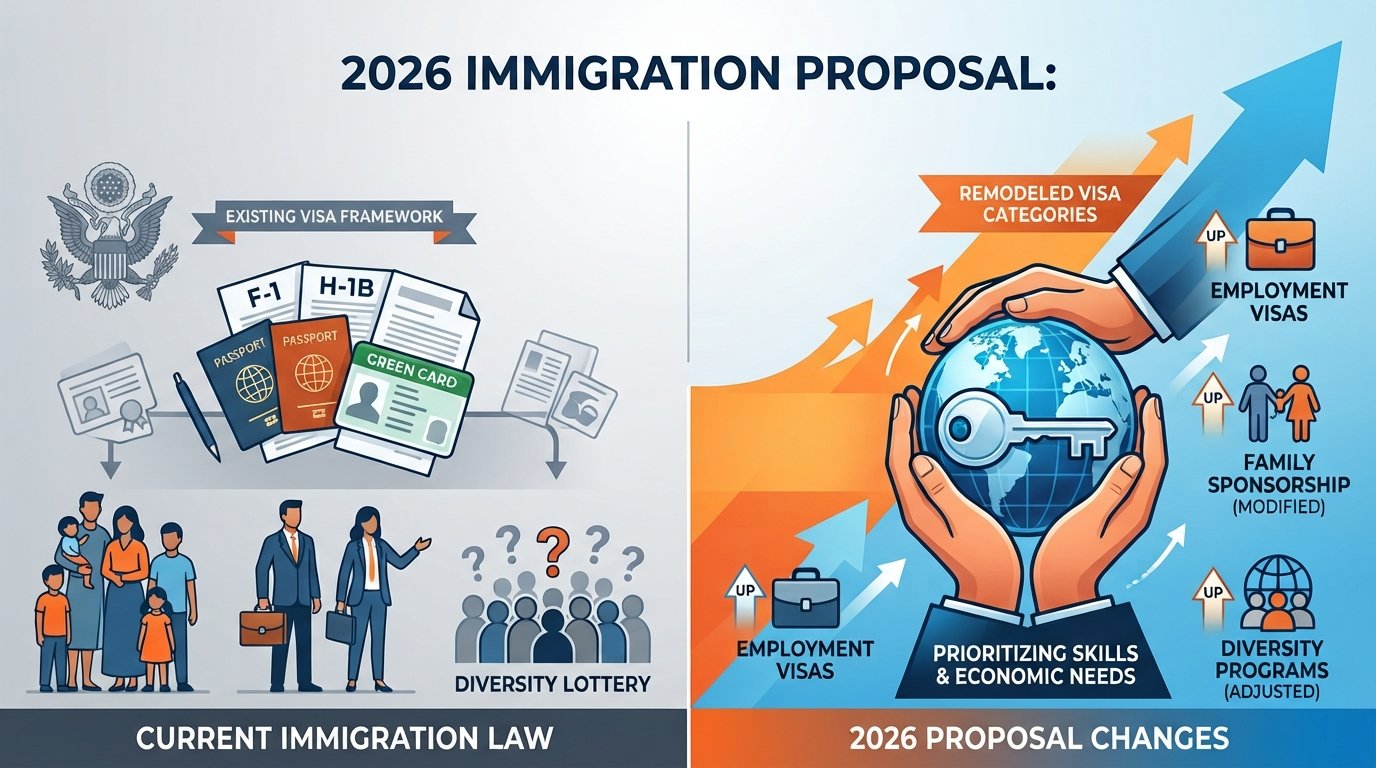
The proposal would eliminate the Diversity Visa Lottery and narrow family-sponsored immigration.
It would also replace existing employment-based green-card categories with a points-based system.
The House proposal would create up to 192,000 employment-based immigrant visas annually, subject to reductions specified in the legislation. Applicants would need at least 16 points and would be evaluated using factors including salary, education, English proficiency, age, military service and extraordinary achievement.
The proposal also includes employer requirements intended to protect U.S. workers.
Employers would have to attest that they made good-faith efforts to recruit U.S. workers. The bill also addresses layoffs involving U.S. workers in essentially equivalent positions.
Tuberville's Senate Bill Is Different
The Senate proposal introduced by Tuberville is S. 4546, the ASSIMILATION Act.
Its official text proposes a broader immigration overhaul. It addresses family immigration, Diversity Visas, employment-based immigration, H-1B visas, Optional Practical Training, public-charge rules, naturalization, asylum, visa overstays and employment verification.
The Senate bill would narrow immediate-relative immigration to spouses and unmarried children under 18 of U.S. citizens.
It would also create a new nonimmigrant category for parents of U.S. citizens aged 21 or older. Those parents could receive five-year periods of admission but would not receive employment authorization or public benefits under the proposal.
That is a significant distinction from the House proposal described in the supplied article.
Diversity Visa Lottery Could End
Both legislative approaches target the Diversity Visa program.
The Senate ASSIMILATION Act would eliminate the diversity immigrant category. It also contains a provision stating that people selected before enactment would not be able to receive a Diversity Visa based on that selection after enactment.
But that does not mean the Diversity Visa program has already ended.
The State Department's current DV-2026 information still describes the existing program and says DV-2026 selectees must obtain their visas or adjustment of status by September 30, 2026.
So someone reading about these bills should not assume that a current Diversity Visa selection has already been cancelled because of the proposed legislation.
Family Immigration Would Face Major Changes
The family provisions could affect parents, children and other relatives differently.
Under the Senate ASSIMILATION Act, immediate-relative treatment would cover spouses and unmarried children under 18 of U.S. citizens.
The bill would replace the current broader family-preference structure with a category for spouses and children under 18 of lawful permanent residents. It proposes an 88,000 worldwide level for that family-sponsored category, subject to reductions specified in the legislation.
Parents of U.S. citizens would face a particularly important change.
Instead of qualifying for an immigrant visa as immediate relatives, they could receive a proposed nonimmigrant status.
That status would not create eligibility for an immigrant classification or adjustment of status unless another law expressly provided it.
May Also Like: Forget the Degree? 5 Skills That Can Lead to $1M+ Careers
The House Americans First bill also would sharply narrow family-based immigration, although its specific provisions differ from the Senate legislation.
Employment Green Cards Could Become More Selective
The biggest problem with the supplied article is that it attributes the House bill's points system to Tuberville's Senate legislation.
The Senate ASSIMILATION Act uses a different structure.
It would cap employment-based immigrant visas at 140,000 annually. Applicants would need to establish that their admission serves the national interest under standards written into the bill.
The proposal identifies several positive factors.
One includes a job offer paying at least the 90th-percentile salary for the relevant occupation and location.
Another covers certain national-interest occupations or shortage positions. The bill also includes provisions involving strategic federal support, investment and extraordinary ability.
The bill also identifies negative factors.
These include compensation below the applicable median or prevailing wage, limited English proficiency, certain serious employer labor violations and insufficient evidence of self-sufficiency.
That is materially different from the 16-point system described in your original article.
H-1B Workers Could Also Be Affected
The Senate proposal goes beyond permanent immigration.
It would impose additional H-1B wage requirements.
Under the bill, an employer generally could not receive approval for an H-1B petition unless the wage reached at least 200% of the median wage for the occupation and location. The bill would also prioritize certain applicants with U.S. STEM degrees.
The official bill text also includes reforms affecting Optional Practical Training.
That means international students could have a separate reason to watch the legislation if they plan to remain in the United States after graduation.
Would Current Green-Card Holders Lose Their Status?
Not because these bills were introduced.
Introduction of legislation does not itself change an immigrant's current legal status.
A person with lawful permanent residence does not lose that status simply because H.R. 8586 or S. 4546 exists.
The practical situation could change only if Congress enacted legislation containing applicable provisions.
The exact consequences would then depend on the final statutory language, effective dates and transition rules.
This is why immigrants should not treat headlines about the proposals as notices that their existing green cards have been cancelled.
What About Pending Immigration Cases?
This is one of the most important questions.
The answer depends on the particular bill and the particular immigration category.
The House Americans First proposal contains provisions affecting existing petitions and immigration categories. The Senate ASSIMILATION Act separately contains transition and applicability provisions.
A pending petition therefore cannot be evaluated simply by asking whether it was filed before the bill.
Applicants would need to examine the final legislation if Congress enacted it.
Until then, the proposals themselves do not automatically terminate pending immigration cases.
Public Charge Rules Are a Separate Issue
Immigrants should also avoid confusing these bills with current executive or agency immigration policies.
The Department of State currently operates a pilot procedure under which certain immigrant-visa applicants may be required to apply for a public-charge bond. The department says the procedure operates under existing law and regulations.
Separately, the State Department said in August that a January 2026 pause on immigrant visa issuance to nationals of 75 countries was no longer in effect following a federal court order.
Those developments are current administrative policies and court-related developments, not provisions of the Tuberville bill.
Keeping those categories separate is essential when reporting immigration news.
What Happens to Current Diversity Visa Applicants?
For DV-2026 applicants, the existing program remains governed by current law and State Department procedures unless a new law changes that situation.
The State Department says DV-2026 selectees must receive their immigrant visas or adjustment of status by September 30, 2026. It also says selectees who do not obtain the required status by that date receive no further benefit from their DV-2026 registration.
A proposed bill therefore should not be described as retroactively cancelling DV-2026 unless the legislation actually becomes law and its provisions apply.
Do Immigrants Need to Take Action Now?
For most readers, the key point is simple:
The proposed legislation does not itself change immigration law today.
People with active immigration cases should continue following the requirements and deadlines applicable to their current category.
Applicants should also distinguish between:
- A bill introduced in Congress
- A bill passed by one chamber
- A bill passed by both chambers
- A law signed by the president
- An agency rule implementing that law
- A court order affecting implementation
Those are different legal events.
What Happens Next?
Both bills face the normal legislative process.
H.R. 8586 remains a House proposal referred to committees. S. 4546 remains a Senate proposal referred to the Judiciary Committee.
The House left Washington on September 16 for a scheduled pre-election recess and was not expected to return for regular business until November.
The Senate's September 16 calendar showed Republicans holding 53 seats, Democrats 45 and two independents.
The bills could still change substantially during the legislative process.
They could also fail to advance.
No current immigration benefit should therefore be treated as eliminated solely because these proposals were introduced.
Immigration FAQ
Is the Americans First Immigration Act already law?
No. H.R. 8586 was introduced in the House on April 29, 2026, and referred to committees.
Did Tommy Tuberville introduce the Americans First Immigration Act?
No. Tuberville introduced S. 4546, the ASSIMILATION Act. Rep. Barry Moore introduced H.R. 8586, the Americans First Immigration Act.
Would the Diversity Visa Lottery end immediately?
No. The proposals would change the law only if enacted. Current DV-2026 procedures remain governed by existing law and State Department rules.
Could parents of U.S. citizens still receive immigrant visas under current law?
Yes, current law still provides an immediate-relative category for parents of U.S. citizens who meet the applicable requirements. The proposed legislation would change that framework if enacted.
Would current green-card holders automatically lose their status?
No. Introduction of these bills does not automatically cancel existing permanent residence.
Could H-1B workers be affected?
Potentially, if the Senate ASSIMILATION Act were enacted. The proposal includes substantially higher wage requirements for H-1B positions and other reforms.
Would international students be affected?
Potentially. The Senate proposal addresses Optional Practical Training and would change the statutory framework governing that program.
Does the legislation affect everyone with a pending immigration case?
Not necessarily. The effect would depend on the immigration category, the specific legislation enacted and its transition provisions.
Should immigrants change their current immigration strategy because of the bills?
The legislation is still proposed. Anyone with an individual immigration case should base legal decisions on current law and their specific circumstances, rather than assuming a proposed bill has already taken effect.