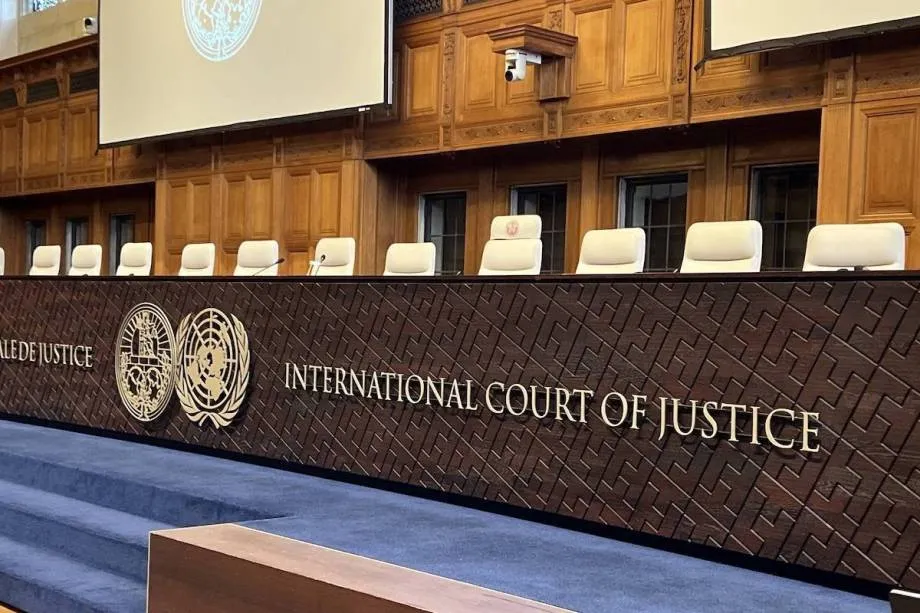
He highlighted the Court’s record-high caseload, recent legal developments, institutional reforms and plans to modernize judicial procedures. He also marked the Court’s 80th anniversary and outlined priorities for improving efficiency and outreach.
President Iwasawa began by thanking the General Assembly for its continued interest in the Court’s work. He also congratulated Dr. Khalilur Rahman on his election as president of the Assembly’s 81st session.
The president described the Court’s 80th anniversary as a significant milestone. He said the occasion had encouraged reflection, renewed commitment to progress and stronger efforts to explain the Court’s mandate and activities.
To mark the anniversary, the Court held a solemn sitting on April 17, 2026. It also launched the Judicial Fellows Alumni Association and published an illustrated book titled The International Court of Justice: 80 Years in the Service of Peace and Justice.
ICJ Reports 24 Pending Cases and a Record Caseload
The Court also prepared a second anniversary publication, The International Court of Justice at 80: An Inside View. The book features perspectives from current and former Court members, judges ad hoc and Registry officials. The Court scheduled its official launch at the Trusteeship Council for later Wednesday.
Meanwhile, a dedicated photo exhibition opened in the General Assembly building’s Visitors’ Lobby. The exhibition highlights the Court’s jurisprudence and its development over the years.
Turning to judicial activities, President Iwasawa reported a record-high caseload. The Court’s docket contained 25 cases on August 1, 2025, the starting date for the reporting period.
He said 24 contentious cases remained pending before the Court. These cases cover a broad range of international legal issues. The Court also received one new contentious case during the period under review.
Court Holds Hearings and Issues Major Decisions
Since August 1, 2025, the Court has held hearings in five cases. It has also delivered one judgment on intervention and issued two advisory opinions.
In addition, the Court issued an order on a request for provisional measures and another on the admissibility of counterclaims. It also issued several orders setting time limits and one order discontinuing proceedings.
President Iwasawa reviewed these decisions and outlined the Court’s ongoing work. He said the judges were deliberating on the merits of two cases.
The first concerns the Application of the Convention on the Prevention and Punishment of the Crime of Genocide (The Gambia v. Myanmar), in which 11 states are intervening. The second concerns the Arbitral Award of 3 October 1899 (Guyana v. Venezuela).
The Court is also deliberating on preliminary objections in Alleged Breaches of Certain International Obligations in respect of the Occupied Palestinian Territory (Nicaragua v. Germany).
ICJ Introduces Changes to Rules on Evidence
President Iwasawa said the Court regularly reviews its rules and procedures to maintain effective judicial practices. As part of this effort, the Court recently amended Articles 50 and 56 of its Rules.
It also amended several Practice Directions governing document submissions in proceedings. The changes primarily aim to clarify the framework for handling evidence.
The amendments will take effect on February 1, 2027. Transitional provisions will apply to contentious cases already pending before the Court.
These changes form part of the Court’s continuing efforts to refine its procedures. They also address the practical demands of managing complex international disputes and their supporting documentation.
Judicial Fellowship Programme Supports 19 Fellows
The president also updated the General Assembly on the Trust Fund for the Court’s Judicial Fellowship Programme. The secretary-general established the fund in 2021 at the General Assembly’s request.
Since its creation, the fund has supported an average of three or four judicial fellows annually. President Iwasawa said donor contributions and the initiative had enabled 19 fellows to participate in the programme.
The fellows received nominations from universities in 17 countries: Brazil, Chile, Congo, Eritrea, Georgia, Guatemala, India, Iran, Kenya, Mexico, Mongolia, Pakistan, the Philippines, South Africa, Tanzania, Tunisia and Türkiye.
President Iwasawa expressed confidence that the programme would continue to grow. The initiative provides opportunities for fellows to gain experience and engage with the Court’s judicial work.
He also updated delegates on the asbestos situation at the Peace Palace in The Hague, the Court’s headquarters. However, his address did not provide further details on the issue.
ICJ Seeks Technology Investment in 2027 Budget
President Iwasawa concluded by addressing the Court’s budget and resource requirements. He thanked the General Assembly for approving additional resources in recent years.
For its 2027 budget request, the Court has prioritized greater efficiency through technology. The proposal includes implementing a case management system to handle the growing volume of case-related documents.
The Court considers the system essential for managing documentation securely, efficiently and systematically. It would also support the administration of the Court’s expanding judicial workload.
President Iwasawa urged member states to support the proposal. He said the investment would harness new technologies and streamline judicial procedures.
The proposed system reflects the Court’s broader effort to modernize its operations while managing an increasingly demanding caseload. Its implementation will depend on the budgetary support provided by member states.
As the ICJ marks 80 years of service, its priorities include managing complex cases, refining procedural rules and strengthening institutional capacity. The Court’s latest report highlights both its expanding judicial responsibilities and its push for greater efficiency.