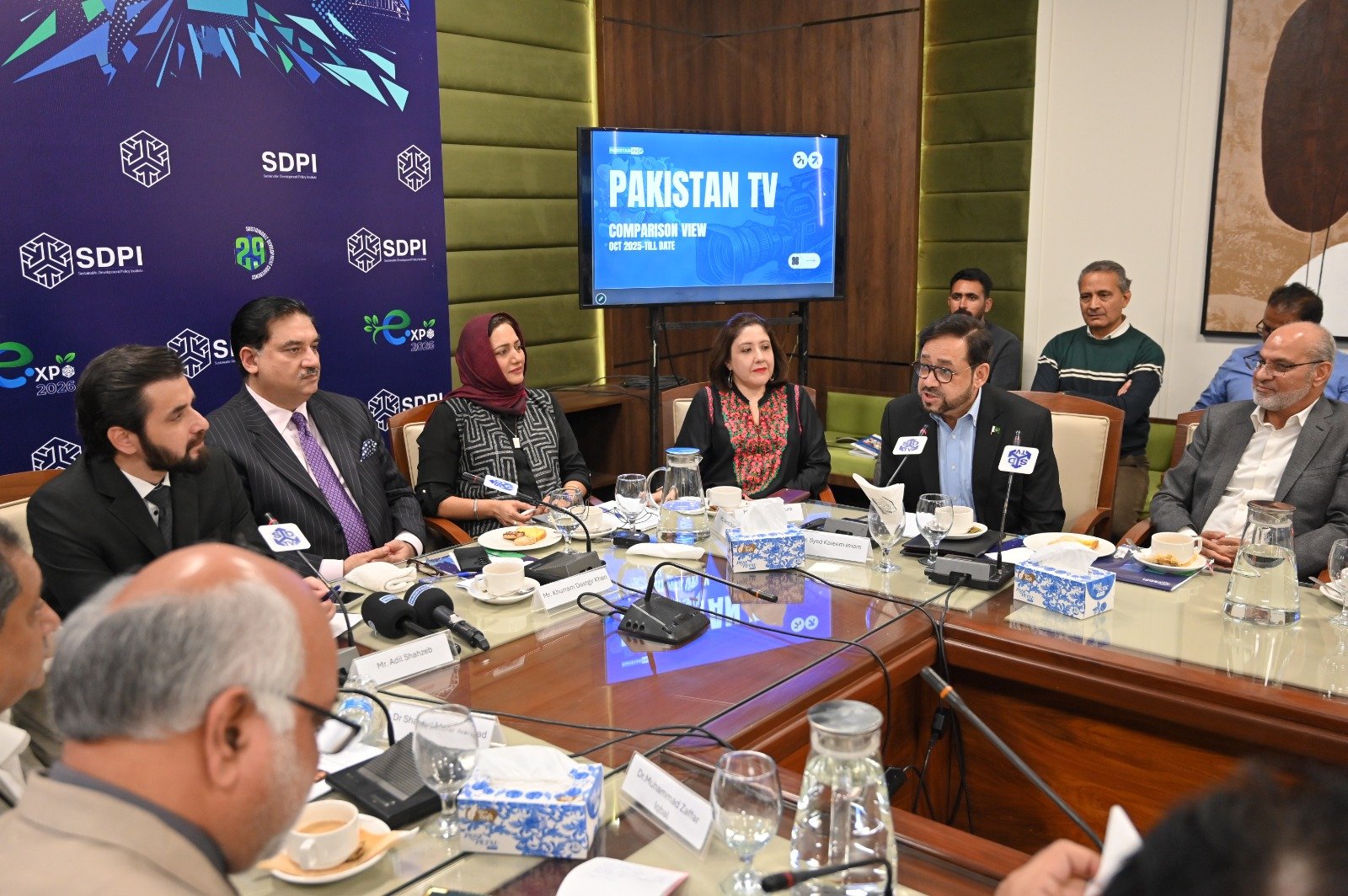
The session, titled “Pakistan’s Reform Agenda for Integrated Economic Governance”, was organized on the third day of 29th Sustainable Development Conference by Sustainable Development Policy Institute.
Participants highlighted the need for coordinated reforms to translate macroeconomic stability into industrial growth, employment generation, export expansion and improved living standards.
Mirza Ikhtiar Baig, MNA and member of the National Assembly Standing Committee on Finance, Commerce and Economic Affairs, said Pakistan had achieved fiscal consolidation and moved away from the immediate risk of default but had failed to translate economic stability into employment generation, export growth and relief for ordinary citizens.
He criticized restrictions on letters of credit (LCs) for essential imported raw materials, including dyes, chemicals and polyester fibre, saying such disruptions undermined export-oriented industries and affected their ability to meet international orders.
Dr Muhammad Ali Talpur, Chief Economist at the Planning Commission, said political stability, policy consistency and effective implementation were essential for sustainable economic growth. He said the government had developed a long-term economic strategy under a five-year plan, supported by annual plans and a mid-term review to assess sectoral performance and introduce necessary policy adjustments.
Renowned economist Khaqan Najeeb identified a serious competence crisis in both the public and private sectors. He attributed weaknesses in private businesses partly to family-run ownership structures that often restricted professional management, institutional development and business expansion.
Criticizing Pakistan's repeated reliance on the International Monetary Fund (IMF), he said the country had entered 25 IMF programmes over 79 years but had remained dependent on external assistance for decades. He stressed the need to address structural weaknesses instead of repeatedly relying on external financial support.
Speaking at another session, titled: 'Operationalizing country platforms for climate finance in Pakistan: Readiness and Gaps’, Rana Ihsaan Afzal Khan Pakistan faces an estimated climate finance gap of $348 billion by 2030, requiring concessional financing, private investment and equitable access to global carbon markets to support its transition towards a climate-resilient economy, said Coordinator to the Prime Minister on Commerce and Industries.
He said Pakistan is moving from policy formulation to implementation through its Climate Prosperity Plan, Pakistan Green Taxonomy and a multi-sectoral country platform aimed at aligning international climate finance with national priorities.
Adviser to the Finance Minister Adnan Pasha said the Finance Division was committed to leading the institutional architecture for climate finance mobilization, stressing that the initiative must move beyond dialogue towards a concrete implementation plan. Describing climate change and population growth as existential risks, he said the Finance Division would facilitate projects undertaken by federal ministries and provincial governments.
At a Roundtable, titled: “Making Tariff Reforms Work for Industry and Exports, experts at a roundtable called for coordinated industrial, trade and taxation reforms, saying tariff rationalization alone cannot transform Pakistan’s economy without improvements in productivity, infrastructure, energy costs, access to technology and a predictable business environment,
Dr Anil Salman, Chair, Economic Security, Islamabad Policy Research Institute (IPRI), criticized the government's tendency to formulate economic policies in isolation, saying the NTP needed to be aligned with industrial and taxation policies. He called for continuous monitoring instead of waiting for fixed three- or five-year reviews. Performance should be measured through new industries and exporters, productivity improvements and actual export growth.
Dr Manzoor, international trade and customs facilitation expert, argued that Pakistan did not need an existing exportable surplus before opening its economy to international trade. Citing Vietnam, he said, investment, openness and access to imported inputs could create new industries and export capacity.
Loui Dane from British High Commission Loui Dane said Pakistan remained among the countries with the most restrictive trade regimes, according to research conducted in
2022. Drawing a comparison with the English Premier League, he said international participation by foreign players and coaches had improved standards and productivity. Similarly, greater exposure to international competition could help Pakistani industries acquire technology, expertise and competitiveness.
Dr Kaiser Bengali argued that Pakistan’s industrial problems went beyond tariff structures, saying the country lacked a coherent industrial transformation policy. Its narrow export base and dependence on imported inputs had restricted industrial development, while prevailing incentives encouraged investment in real estate, shopping malls and other activities offering higher returns than manufacturing.
He called for policies that rewarded productive investment, local processing and job creation rather than speculation and vested interests.
Mr Suleman Ghani, former federal secretary for Industries and Commerce, questioned the need for a separate Ministry of Industries, suggesting that its functions could be incorporated into the Ministry of Commerce, while specialised institutions such as the Engineering Development Board could perform technical functions. He said industrial development primarily required skilled labour, realistic exchange rates and rational tariffs to attract investment and technology.
Later, at a policy dialogue, titled: "From Coal to Clean: Towards a Phased, Just Energy Transition", energy experts, policymakers and development practitioners have called for a phased, financially viable transition from coal-fired electricity to renewable energy in Pakistan, warning that rising capacity payments, declining coal plant utilization and rapid solar adoption are exposing structural weaknesses in the country's power sector.
Former federal minister for climate change Malik Amin Aslam said Pakistan had access to international financing mechanisms for retiring coal-fired power plants but lacked the political will to implement reforms. He said Pakistan's rapid solar expansion demonstrated that households and businesses were already pursuing cleaner electricity, while government policies had failed to keep pace.
Michael Williamson from the United Nations Economic and Social Commission for Asia and the Pacific (UNESCAP) said Pakistan faced a complex challenge because most coal-fired power plants were commissioned after 2015 and retained substantial financial obligations.
Member of the National Assembly Riaz Fatyana called for reducing electricity tariffs, rationalizing renewable energy taxes and encouraging competition in alternative energy markets. He proposed developing small hydropower projects along Punjab's canal network to provide affordable, clean electricity to surrounding villages.
Dr Christoph Nedopil Wang, an international energy transition expert, stressed that coal retirement financing must reflect realistic asset valuations based on future electricity demand rather than contractual expectations.
However, Ali Nawaz Leghari of the Private Power and Infrastructure Board defended the historical development of coal plants, explaining that they were established to address severe electricity shortages. He said converting imported coal plants to indigenous Thar coal could reduce fuel imports and strengthen energy security. Reliable generation, he maintained, remained necessary alongside renewable energy expansion and battery storage.