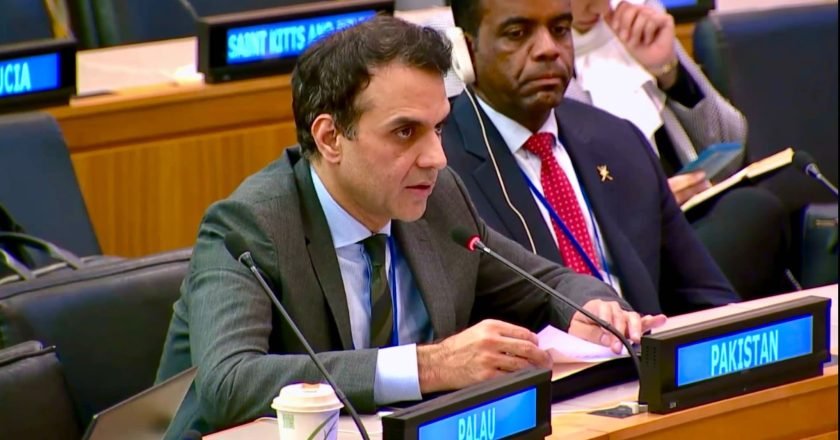
Speaking at an Arria-formula meeting of the United Nations Security Council on “Natural Resources and Conflict: Fostering Cooperation for Prevention and Peace”, Pakistan's Deputy Permanent Representative to the UN Ambassador Usman Jadoon, said shared natural resources must not be used as tools of political pressure or coercion.
The meeting was organised by Liberia, a member of the UN Security Council.
Ambassador Jadoon said the Permanent Court of Arbitration, in its August 31, 2026 ruling, had reaffirmed that the Indus Waters Treaty remained in force and that India was bound by its obligations under the agreement.
He stressed that no country could unilaterally suspend its obligations under an international treaty or use shared natural resources to exert political pressure on another country.
Referring to UN Security Council Resolution 2788 and Article 33 of the UN Charter, he emphasised the importance of peaceful dispute resolution, particularly in the management of shared transboundary natural resources such as water.
The Pakistani envoy said natural resources should serve as instruments of sustainable development, shared prosperity and peace rather than exploitation and conflict.
He also expressed solidarity with African countries seeking sovereign control over their natural resources, noting that foreign interference, illegal exploitation, political exclusion, weak institutions and unequal distribution of resource wealth often fuel conflicts.
Citing the Democratic Republic of Congo as an example, he said its vast mineral wealth had continued to contribute to conflict instead of bringing prosperity to its people.
Ambassador Jadoon outlined three priorities for preventing resource-related conflicts: addressing their underlying political and governance causes through inclusive dialogue and equitable resource distribution; promoting transparency and international cooperation to prevent illegal resource trafficking and conflict financing; and ensuring that developing resource-rich countries benefit from investment, local processing, technology transfer and value addition.
He called for the management of natural resources to remain consistent with the UN Charter, international law and the principle of permanent sovereignty over natural resources, recognised under UN General Assembly Resolution 1803.
Indian Comments Rejected
Separately, Pakistan exercised its right of reply after remarks by the Indian representative at the Security Council meeting.
First Secretary Ansar Shah rejected India's comments, accusing New Delhi of attempting to divert attention from the Indus Waters Treaty issue through what he described as baseless allegations and political rhetoric.
He said the 1960 Indus Waters Treaty was a binding international agreement and contained no provision allowing either party to unilaterally suspend it.
Responding to India's argument that circumstances had changed since the treaty was signed, Shah questioned whether India also considered the UN Charter and Security Council resolutions outdated.
He also raised the issue of Jammu and Kashmir, referring to UN Security Council resolutions on the disputed territory and alleging continued human rights violations by Indian forces.
Shah further rejected what he described as inappropriate remarks by India's permanent representative concerning Pakistan's internal affairs, reaffirming Islamabad's commitment to international law, constitutional supremacy and democratic principles.
He said using water, which was essential to the lives and livelihoods of more than 240 million Pakistanis, as a political weapon amounted to coercion rather than a legitimate review of an international agreement.
The Pakistani diplomat urged India to respect international law, honour its treaty obligations and maintain peaceful relations with neighbouring countries.
He added that the Indus Waters Treaty issue was fundamentally about respecting international agreements and preventing shared natural resources from becoming instruments of conflict.