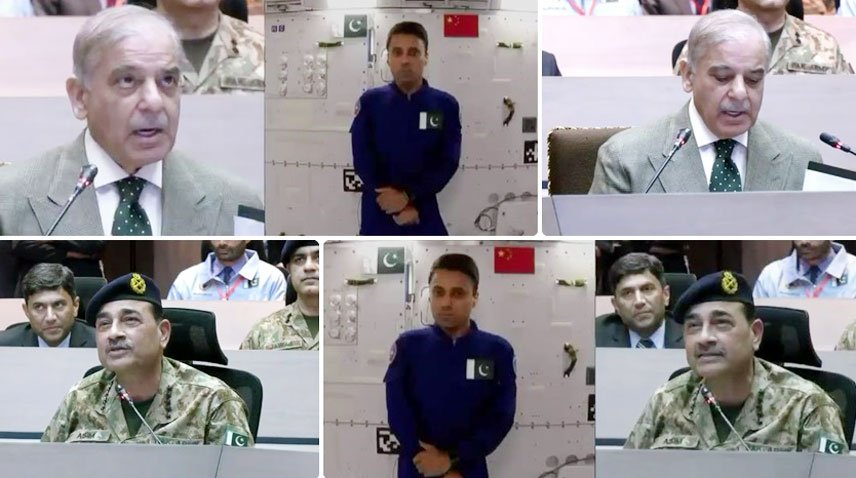
The interaction took place during the prime minister’s visit to the Space and Upper Atmosphere Research Commission (SUPARCO) in Islamabad.
RELATED: Pakistan’s First Astronaut Reaches China’s Space Station in Historic Mission
Shehbaz Sharif expressed pride in Zeeshan Ali, describing his mission as the beginning of Pakistan’s human spaceflight journey. He said the knowledge and experience gained during the mission would contribute to the country’s progress in science and technology.
The prime minister said the mission reflected Pakistan’s commitment to the peaceful use of outer space for the benefit of humanity. He added that the scientific experiments being conducted by Zeeshan Ali alongside his Chinese crewmates would contribute to international scientific knowledge.
Highlighting Pakistan-China relations, Shehbaz Sharif said the two countries’ friendship had now extended beyond the skies. He noted that the mission coincided with the 75th anniversary of diplomatic relations between the two countries.
He thanked Chinese President Xi Jinping for supporting bilateral cooperation and said China had given Pakistan the distinction of becoming its first foreign partner in its space programme.
Field Marshal Asim Munir said Pakistan and its armed forces were proud of Zeeshan Ali, describing his presence aboard the Chinese space station as a reflection of the longstanding strategic partnership between the two countries.
Speaking to the Pakistani leadership, Zeeshan Ali said it was an honour to represent Pakistan as its first astronaut to orbit the Earth and the first international astronaut to enter the Chinese space station.
READ MORE: China to launch Shenzhou-24 crewed spaceship tomorrow
He said the mission was progressing according to plan and that he was performing his assigned duties and scientific research to the best of his ability. He expressed hope that future generations of Pakistani astronauts, engineers and scientists would travel farther into space.
Earlier, the SUPARCO chairman said Zeeshan Ali would conduct four scientific experiments designed by Pakistani universities, adding that the country’s space programme was making steady progress.