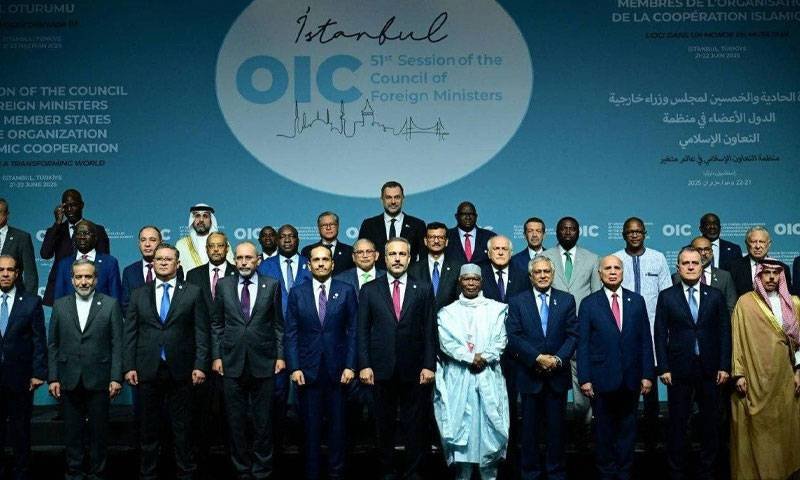
The meeting was held under the theme “Dialogue and Solidarity: Two Essential Pillars for Peace and Sustainable Development.”
During the session, Turkish Foreign Minister Hakan Fidan handed over the council’s chairmanship to Iraqi Foreign Minister Fuad Mohammed Hussein. More than 70 resolutions were adopted, covering the situations in member states, Palestine, Jammu and Kashmir, Muslim minorities, the protection of community rights and efforts to combat Islamophobia.
The meeting also reviewed the OIC’s economic, social, humanitarian, cultural and scientific programmes and activities.
Pakistan was represented by its Permanent Representative to the OIC, Ambassador Syed Muhammad Fawad Sher, on behalf of Deputy Prime Minister and Foreign Minister Ishaq Dar.
Sher delivered Pakistan’s national statement, strongly condemning what he described as Israel’s ongoing genocide against the Palestinian people and expressing deep concern over Israeli actions in the occupied Palestinian territories, including the West Bank and East Jerusalem.
He reaffirmed Pakistan’s full support for the establishment of a secure, viable, geographically contiguous and sovereign Palestinian state based on pre-June 1967 borders, with Al-Quds Al-Sharif as its capital.
Sher also highlighted the hardships faced by people in Indian Illegally Occupied Jammu and Kashmir (IIOJK), welcoming the OIC’s continued support for their cause. He called for concrete measures to ensure the Kashmiri people’s right to self-determination in accordance with relevant United Nations Security Council and OIC resolutions and their aspirations.
Emphasising the importance of unity among Muslim countries, the Pakistani representative underscored the OIC’s role in addressing shared challenges related to peace, security and development.
He reiterated Pakistan’s support for Saudi Arabia against Houthi attacks and reaffirmed support for Yemen’s sovereignty, unity and territorial integrity.
Sher also represented Ishaq Dar at a ministerial consultative meeting held on the sidelines of the session. He highlighted Pakistan’s role in mediation between Iran and the United States, stating that Islamabad’s diplomatic efforts to reduce tensions and promote wider regional stability had resulted in a ceasefire and the signing of the Islamabad Memorandum of Understanding.
The session concluded with the adoption of the Baghdad Declaration, which reflected the member states’ shared positions on key issues confronting the Muslim world, including Palestine, Jammu and Kashmir, Islamophobia, regional security and other contemporary challenges.