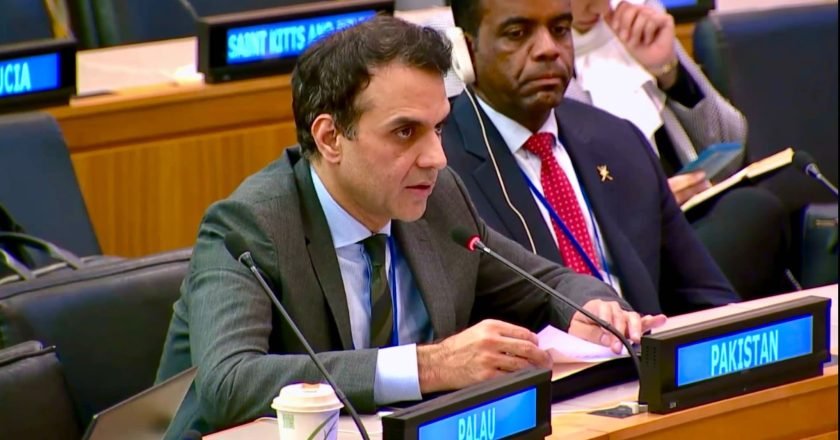
Speaking at the General Debate of the UN General Assembly’s Second Committee, Deputy Permanent Representative of Pakistan, Ambassador Usman Jadoon, said developing countries have been facing severe development challenges amid the combined impact of conflicts, climate change, the COVID-19 pandemic and food, fuel and financial crises.
On climate action, Ambassador Jadoon called for a credible pathway to mobilize US$300 billion in climate finance, including through grants and concessional finance, alongside a tripling of adaptation finance and adequate capitalization of the Loss and Damage Fund. He expressed Pakistan’s support for Türkiye and Australia in their efforts to make COP31 a “COP of delivery.”
Highlighting the critical importance of water security, he called for the 2026 and 2028 UN Water Conferences to address the full spectrum of water-related challenges, particularly cooperation over shared water resources. He underscored the need to respect international law and uphold the sanctity of existing treaties governing transboundary waters.
Ambassador Jadoon stressed that the international community must also address the estimated US$4 trillion annual SDG financing gap. He outlined Pakistan’s priorities, including strengthening domestic resource mobilization in developing countries, scaling up predictable international public finance, reforming the international debt architecture, and revitalizing the multilateral trading system.
The Deputy Permanent Representative welcomed ongoing negotiations towards a UN Framework Convention on International Tax Cooperation, calling for a more equitable distribution of taxing rights, and urged developed countries to honour their 0.7 per cent ODA commitment. He also called for progress on tripling multilateral development bank lending capacity, improving lending terms and reducing borrowing costs, including through fairer credit ratings.
On debt, Ambassador Jadoon highlighted the importance of giving developing countries a greater voice in the international financial architecture. He reaffirmed Pakistan’s support for the Borrowers’ Platform, noting Pakistan’s role as Vice-Chair of the working group that steered its launch, and called for the intergovernmental process on debt to begin without delay.
He further emphasized the need to restore trade as an engine of development, including through revitalization of the WTO’s two-tier dispute settlement mechanism, preservation of special and differential treatment, progress on agriculture and an end to unilateral trade-restrictive measures.
Addressing emerging technologies, Ambassador Usman Jadoon warned that the AI divide could become the new face of the development divide. He called for greater attention to the development dimension of AI governance, operationalization of the WSIS+20 AI capacity-building fellowship and concrete progress towards establishing a3 Global Fund for AI.
On UN development operations, he underscored the importance of national ownership and responsiveness to the priorities of programme countries, stressing that reforms should ultimately be judged by their impact on delivery on the ground.