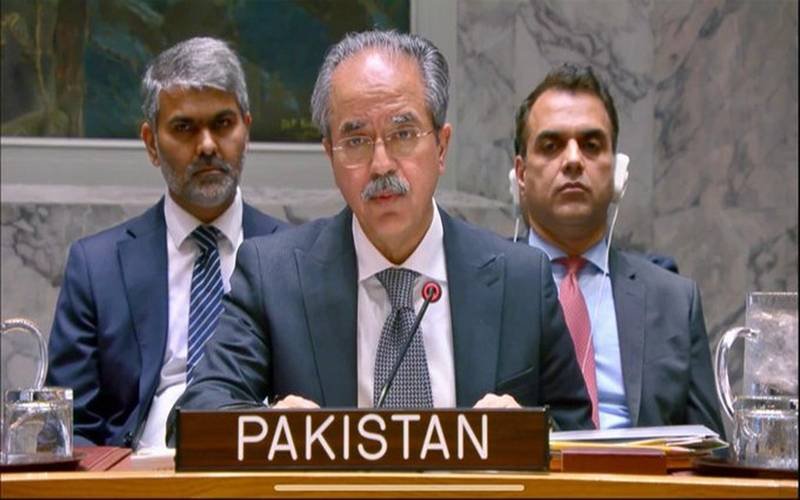
The meeting, hosted by Pakistan’s Permanent Mission to the UN under the theme “Upholding International Law in Situations of Armed Conflict”, was attended by members of the Security Council and representatives of several other countries.
Briefers from the UN Office for the Coordination of Humanitarian Affairs (OCHA), International Committee of the Red Cross (ICRC), International Peace Institute (IPI) and World Forum for Peace and Justice highlighted the humanitarian consequences of violations of international law and called for stronger civilian protection, humanitarian access and accountability.
Speaking on behalf of Pakistan, Ambassador Asim Iftikhar Ahmad, Pakistan’s permanent representative to the UN, said the international community needed to close the gap between legal obligations and their implementation.
“The first casualty of war must never be international law itself,” he said, stressing that international rules must be applied consistently, irrespective of geography, politics or identity.
The ambassador described the situations in the Occupied Palestinian Territories and Indian Illegally Occupied Jammu and Kashmir (IIOJK) as enduring tests of the authority of international law and the credibility of the UN Security Council.
Referring to Gaza, he said the destruction, displacement and deprivation there had tested whether the principles of international humanitarian law were being applied equally and without exception.
He called for an end to Israeli occupation and said the Palestinian people should be able to exercise their right to self-determination and live in freedom and dignity.
On Kashmir, Ambassador Asim recalled that the Security Council had adopted more than a dozen resolutions over the past decades providing a framework for a peaceful settlement of the dispute through a free and impartial plebiscite under UN auspices.
“That promise remains unfulfilled while atrocities by the Indian occupation forces intensified,” he said, referring to concerns raised in UN human rights reports and communications by UN special procedures.
He also referred to a joint communication by UN Special Procedures dated Oct 16, 2025, which, according to him, raised concerns over arrests and detentions, demolitions, restrictions on social media and incidents of hate speech and intimidation in the occupied territory.
The ambassador said India’s unilateral measures of Aug 5, 2019, concerning domicile, land ownership and political representation had also contributed to demographic and political changes in the territory.
He warned that the continued failure to resolve the Jammu and Kashmir dispute posed particular risks given the tensions between two nuclear-armed states.
“Unresolved disputes do not disappear with time; they become more dangerous when left unaddressed,” he said, referring to the May 2025 conflict as evidence of the risks involved.
He urged the international community, particularly the Security Council, to translate its resolutions into meaningful action towards a peaceful settlement of the Kashmir dispute in accordance with the UN Charter, relevant Security Council resolutions and the aspirations of the Kashmiri people.
The Pakistani envoy also called for international law to be applied consistently and without selectivity. He urged the Security Council and the wider UN system to make greater use of monitoring, reporting and investigative mechanisms to identify serious violations, demand corrective action, ensure humanitarian access and promote accountability.
“Monitoring must become an instrument of prevention, not merely a record of tragedy,” he said.
He further called for greater emphasis on peaceful means of settling conflicts, including negotiation, mediation, conciliation, arbitration, judicial settlement and the good offices of the UN secretary general.
“The credibility of international law will not be determined by how eloquently we defend it when doing so is politically convenient,” he said, adding that there could be “no hierarchy of victims, no geography of compassion, and no selective legality.”
The international experts at the meeting also stressed that the main challenge facing the international legal order was the persistent gap between international obligations and their implementation.
OCHA’s Aurelien Buffler highlighted the consequences of disregarding international humanitarian law and obstructing humanitarian access, while drawing attention to the growing use of armed drones and emerging technologies, including artificial intelligence, in warfare.
Elyse Mosquini of the ICRC said civilians continued to bear the greatest costs of war and called for stronger political will, restraint by armed forces and consistent implementation of international humanitarian law.
Dr Jenna Russo of the International Peace Institute stressed the need for meaningful consequences for violations to strengthen deterrence and called for greater accountability despite political constraints.
Dr Ghulam Nabi Fai of the World Forum for Peace and Justice said the credibility of the UN depended on implementing its resolutions rather than merely adopting them. He also cited Kashmir as an example of the consequences of unresolved disputes and inadequate implementation of international norms.
Representatives from a large number of countries, including the United Kingdom, France, Russia, China, the United States, Denmark, Greece, Somalia, Qatar, Spain, Malaysia, Japan, Palestine, Brazil, Azerbaijan, Indonesia and Turkiye, also expressed their views during the meeting.