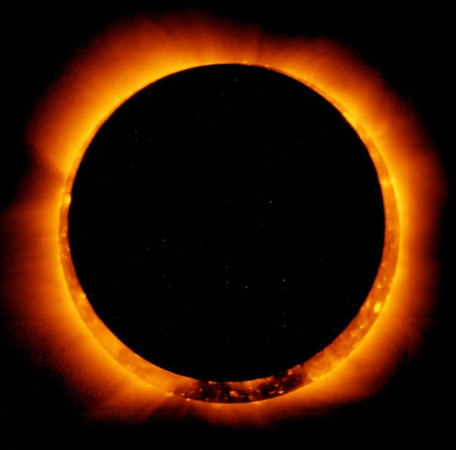
During the total eclipse, the Moon will completely cover the Sun, briefly turning daytime into darkness along the eclipse’s central path. The period of totality is expected to last up to 6 minutes and 23 seconds.
The eclipse will begin over the Atlantic Ocean before crossing parts of Spain, Morocco, Algeria, Tunisia, Libya, Egypt, Sudan, Saudi Arabia, Yemen and Somalia, before ending over the Indian Ocean near the Chagos Islands.
In Pakistan, the partial solar eclipse is expected to begin at around 2:43pm and continue until approximately 4:51pm. In Islamabad, it is expected to start around 3:14pm, reach its peak at 3:47pm and end at about 4:19pm. In Karachi, the eclipse is expected to begin around 3pm and continue until approximately 4:48pm.
Several countries across Europe, Africa and the Middle East will also witness the eclipse in partial form, while the path of totality will pass through a number of countries.
Egypt is expected to be among the key locations for observing the total eclipse, with totality lasting around 6 minutes and 19 seconds in some areas. Certain locations near Sohag and the Red Sea could experience more than six minutes of totality.
Other locations along the totality path include Malaga, Cadiz and Tarifa in Spain; Tangier in Morocco; Oran in Algeria; Sfax in Tunisia; Benghazi in Libya; and Jeddah in Saudi Arabia. In Makkah, totality is expected to last around 5 minutes and 10 seconds.
According to Space.com, around 86 percent of the Sun could be obscured in Madrid, 98 percent in Rabat, about 99.9 percent in Algiers and Tripoli, and approximately 95 percent in Cairo.
A total solar eclipse occurs when the Moon passes between the Earth and the Sun and completely blocks the Sun’s disk for a brief period. During totality, the sky can become significantly darker and the Sun’s outer atmosphere, known as the corona, may become visible.