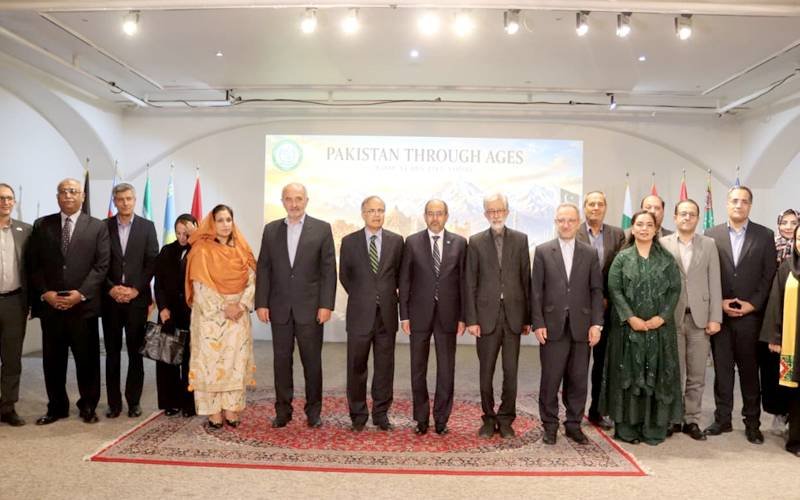
The documentary exploring Pakistan’s historical identity and rich cultural heritage was screened in Tehran on Wednesday at an event organised jointly by the Embassy of Pakistan and ECI, bringing together diplomats, academics and representatives of the arts, culture and tourism sectors.
Titled Pakistan Through Ages, the documentary traces the historical roots of the region that constitutes present-day Pakistan, highlighting the ancient civilisations of Mehrgarh, Gandhara and the Indus Valley, their cultural traditions and the development of languages across the region.
The screening attracted a large number of participants from educational institutions, cultural organisations and diplomatic circles, reflecting interest in the historical connections and cultural heritage shared by the region’s peoples.
Dr Anoushirvan Mohseni Bandpey, Iran’s Deputy Minister of Cultural Heritage, Tourism and Handicrafts, attended the event as the chief guest. Artefacts associated with the ancient civilisations featured in the documentary were also displayed for visitors, offering a closer look at the region’s archaeological and cultural legacy.
Pakistan’s Ambassador to Iran, Imran Ahmed Siddiqui, spoke about the historical journey leading to the establishment of Pakistan and the country’s geographical and cultural significance. His remarks placed the documentary’s historical narrative in the context of Pakistan’s identity and its place within the wider region.
The film explores the origins and development of ancient societies, the emergence of languages, the interaction of different cultural traditions and the historical influences that have shaped the territories of modern Pakistan.
Mehrgarh, one of South Asia’s important early settlement sites, represents a significant chapter in the region’s early agricultural and social history. Gandhara, renowned for its distinctive artistic and Buddhist heritage, reflects centuries of cultural interaction, while the Indus Valley civilisation stands among the major urban civilisations of the ancient world.
Together, these historical traditions offer a broader perspective on the diverse influences that have contributed to the cultural landscape of present-day Pakistan.
Dr Mohseni Bandpey praised the screening, describing it as a positive step towards strengthening people-to-people relations through an appreciation of cultural similarities and shared heritage.
The event highlighted the potential of documentary filmmaking, archaeology and cultural exhibitions to promote mutual understanding between Pakistan and Iran, two neighbouring countries with longstanding historical and regional connections.
By presenting Pakistan’s past through its archaeological sites, languages and cultural traditions, Pakistan Through Ages seeks to place the country’s modern identity within a much longer historical continuum.
The screening also provided a platform for cultural and educational representatives to engage with Pakistan’s heritage beyond contemporary political and diplomatic affairs, underscoring the role of cultural diplomacy in fostering closer relations between the two countries.