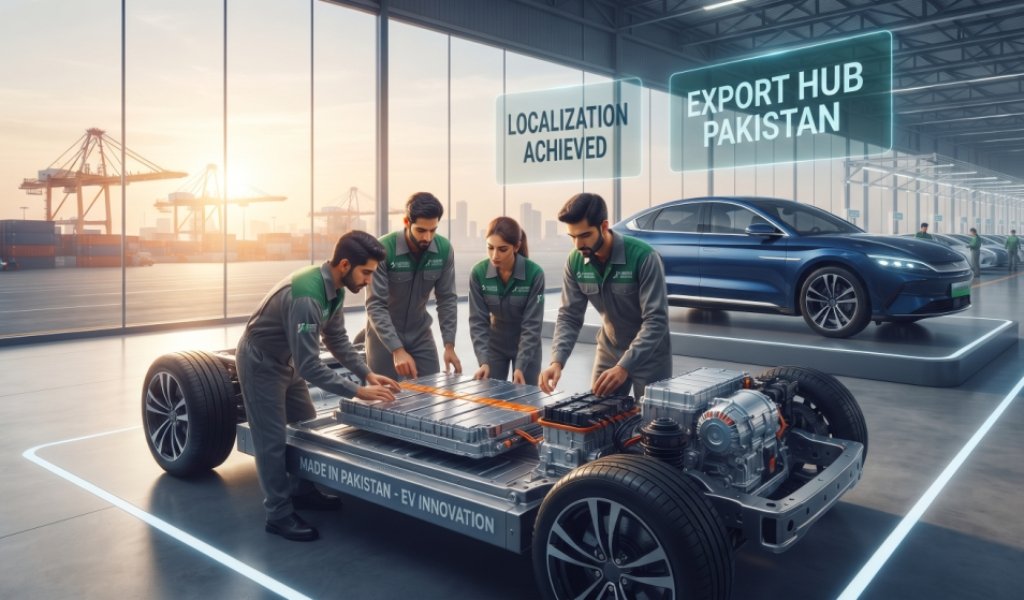
The policy is also moving closer to finalization. On the prime minister’s directions, a committee led by Law Minister Azam Nazeer Tarar has begun daily meetings to expedite the draft. The committee is reviewing the policy clause by clause before final approval.
The policy also seeks to replace ad-hoc decisions with clearer, performance-based rules. Its success, however, will ultimately depend on whether consumers see better prices, safer vehicles, and more reliable deliveries.
That makes the new auto policy more than an industrial strategy. For millions of potential buyers, it could shape how affordable and accessible car ownership becomes in Pakistan.
From Protection to Global Competition
Pakistan’s automotive industry developed behind high tariff barriers for decades. Those protections helped establish domestic assembly operations but limited international competitiveness.
However, the 2026-31 policy changes the focus toward deeper localization and export performance. It links government incentives to metrics such as localization depth and export realization.
Consequently, manufacturers face greater pressure to integrate into global automotive supply chains. Assembly capacity alone will no longer provide the same basis for policy support.
The policy therefore seeks to make international markets a stronger test of Pakistan’s automotive industry.
The Scale Problem
Pakistan’s auto market has also struggled with fragmented production volumes. Multiple brands compete for a relatively limited overall market.
As production spreads across several assemblers, manufacturers lose economies of scale. That fragmentation can increase manufacturing costs and weaken price competitiveness.
The new framework seeks to address this problem through higher capacity utilization. It also encourages contract manufacturing to use existing idle production capacity.
IMF Satisfied with State Bank Briefing as Pakistan Review Talks Continue
Furthermore, manufacturers must pursue more realistic production-volume targets. Without greater scale, locally produced vehicles could struggle against regional competitors.
Auto Parts Could Lead the Export Push
Exporting Completely Built Units remains a difficult long-term objective. International safety, technical, and homologation requirements create additional barriers for Pakistani manufacturers.
Auto parts manufacturing could offer a more immediate export opportunity. Local vendor associations have projected component exports of up to $1 billion.
However, reaching that target would require stronger government support. Proposed measures include concessionary export financing and more practical exporter classification thresholds.
The industry also needs extended realization periods through the State Bank of Pakistan. Long engineering and product-development cycles can make existing timelines difficult for automotive exporters.
NEVs Become a Central Focus of Auto Policy 2026-31
The 2026-31 framework places significant emphasis on New Energy Vehicles. The category includes Battery Electric Vehicles, Range-Extended Electric Vehicles, and Plug-in Hybrid Electric Vehicles.
The government has proposed several measures to support the transition. These include lower duties on charging infrastructure and reduced sales-tax structures for targeted hybrids and EVs.
The framework also proposes viability-gap funding for battery-swapping stations. These measures aim to support cleaner transportation while addressing Pakistan’s energy-import burden.
At the same time, the transition creates new fiscal pressures. Supporting green technology and export incentives requires careful management of government revenues.
The Fiscal Balancing Act
The proposed framework uses Federal Excise Duty as part of its fiscal structure. Additional FED on conventional vehicles would help finance selected NEV incentives and export-support measures.
Committee estimates project significant cumulative FED collections from local and imported vehicles during the five-year policy period. However, the fiscal outlook requires continued scrutiny.
Financial models indicate that early fiscal savings could eventually give way to deficits. Therefore, the government will need rigorous monitoring as implementation progresses.
Major Tax Relief Approved for New Energy Vehicles
The central challenge will involve balancing industrial incentives with sustainable public finances.
Building the Missing Supply Chain
True localization requires more than assembling vehicles locally. Pakistan needs domestic production capabilities for sophisticated components, including electronic control units, transmissions, and critical engine parts.
Previous policy efforts often struggled because local vendors lacked sufficient technology and investment. That limited their ability to manufacture high-precision components.
The new policy introduces stricter compliance monitoring through third-party audits. Persistent non-compliance could result in penalties or license termination.
As a result, suppliers face stronger incentives to upgrade their technical capabilities. The policy could therefore push localization deeper into the automotive supply chain.
Auto Policy 2026-31 Offers Stronger Protection for Car Buyers
Pakistani consumers have long faced problems involving vehicle prices and deliveries. Arbitrary price increases, booking uncertainty, delivery delays, and safety concerns have weakened consumer confidence.
The 2026-31 policy introduces several proposed consumer-protection measures. These include fixed booking rules, penalties for late deliveries, and limits on spare-parts markups.
The framework also proposes adopting dozens of international UNECE WP.29 safety standards. These standards could raise safety requirements for vehicles sold in Pakistan.
Moreover, the policy seeks to distribute post-booking price risks between manufacturers and buyers. Advance payments would influence how those risks are shared.
Mandatory data sharing could also improve transparency across the domestic automotive market.
Policy Stability Remains Critical
Despite its objectives, the framework faces concerns from industry stakeholders. Some vendors fear rapid tariff changes could expose vulnerable micro-vendors to stronger import competition.
Pakistan’s history of abrupt regulatory changes has also contributed to uncertainty. Sudden policy shifts can encourage speculation and undermine long-term investment decisions.
The government therefore faces a second challenge beyond designing the policy. It must demonstrate that rules-based mechanisms can replace discretionary Statutory Regulatory Orders.
That transition will require policy continuity, transparent consultations, and consistent enforcement. Without those safeguards, investors and suppliers may hesitate to make long-term commitments.
The Real Test Begins Beyond the Policy Document
Ultimately, the Automotive Policy 2026-31 will face its strongest test in the real economy. Vehicle prices, production volumes, consumer protection, localization, and export performance will reveal its impact.
The framework seeks to phase out arbitrary exemptions and rationalize tariff structures. It also aims to improve auto financing and connect licensing privileges with measurable performance.
However, policy design alone cannot transform the industry. Implementation discipline, investment, supplier development, and consistent regulation will determine whether the framework delivers its intended results.
If those conditions hold, Pakistan could move beyond a protected assembly-based market. The longer-term objective is a more localized, competitive, and export-oriented automotive industry.
Frequently Asked Questions
1. What are the latest news on the automotive industry in Pakistan?
Pakistan is finalizing its Automotive and Auto Parts Manufacturing Policy 2026-31. A government committee has started daily meetings to accelerate the draft’s completion.
2. What are the current changes to the car import policy in Pakistan?
Pakistan abolished the Personal Baggage Scheme for used-vehicle imports in August 2026. The Gift and Transfer of Residence schemes remain available but now face tighter conditions and regulatory requirements.
3. Which country is No. 1 in car manufacturing?
China remains the world’s largest automobile-producing country. Its 2025 production exceeded 34.5 million vehicles, maintaining its global lead for the 17th consecutive year.
4. Who owns BYD in Pakistan?
BYD's authorized Pakistani distributor is Mega Motor Company (MMC). MMC is jointly owned by Hub Power Holdings Limited and Mega Conglomerate, with each holding a 50% stake.
5. What is the Automotive and Auto Parts Manufacturing Policy 2026-31?
The proposed policy is designed to reshape Pakistan’s automotive industry through stronger localization, exports, new-energy vehicles, investment, and performance-linked incentives. The government is currently reviewing the draft before finalization.