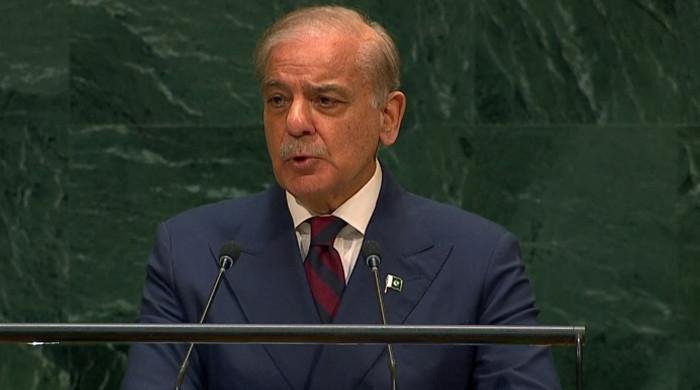
Beginning his address with the recitation of a verse from the Holy Quran, the prime minister said he was representing the peaceful people of Pakistan.
He recalled Quaid-i-Azam Muhammad Ali Jinnah’s support for the UN Charter. He said its principles had guided Pakistan’s conduct at home and abroad.
Pakistan Pushes for Diplomacy Amid Regional Tensions
Speaking about tensions in the Gulf and wider Middle East, Shehbaz said Pakistan had played a diplomatic role.
He said Pakistan brought the United States and Iran together in Islamabad. He referred to the Islamabad talks and the memorandum of understanding reached between the two sides in June.
The prime minister praised Chief of Defence Forces and Chief of Army Staff Field Marshal Asim Munir for helping create space for diplomacy under difficult circumstances.
He also acknowledged Deputy Prime Minister and Foreign Minister Ishaq Dar’s role in the diplomatic process.
“Amid the roar of missiles, drones and guns, the voice for diplomacy must echo even louder and stronger,” Shehbaz said.
Islamabad Talks Highlight Pakistan’s Diplomatic Role
The prime minister highlighted Islamabad’s efforts to facilitate dialogue between Washington and Tehran.
He pointed to the talks and the June memorandum of understanding as examples of Pakistan’s diplomatic engagement.
Shehbaz also credited Pakistan’s senior leadership with supporting efforts to create space for negotiations during regional tensions.
Hormuz and Bab al-Mandab Called Vital Trade Routes
Shehbaz described the Strait of Hormuz and Bab al-Mandab as “arteries of the global economy.”
He stressed that the waterways must remain open to facilitate international trade and connectivity.
He warned against allowing the strategic routes to become chokepoints for confrontation.
Pakistan Condemns Attacks on Saudi Arabia and Makkah
The prime minister also condemned recent Houthi attacks on Saudi Arabia.
He said an attack on the holy city of Makkah had caused anger and concern among Muslims worldwide.
Shehbaz reaffirmed Pakistan’s support for the Saudi people. He said the protection of the holy sites was a red line.
The prime minister said the Makkah agreement was not directed against any country. He described it as a collective effort for regional defence and peace.
Shehbaz Credits Trump Role in Pakistan-India De-escalation
Turning to South Asia, the prime minister said Pakistan had exercised its right to self-defence under Article 51 of the UN Charter during the recent conflict with India.
He credited Field Marshal Asim Munir’s leadership in Pakistan’s response.
Shehbaz also said US President Donald Trump’s role had helped prevent further escalation between the two nuclear-armed neighbours.
He described Pakistan and India as having been close to open conflict. Shehbaz stressed that steps must be taken to prevent a recurrence of such tensions.
Pakistan Reasserts Position on Kashmir
On Kashmir, the prime minister called for a UN-supervised plebiscite.
He alleged that collective punishment and attempts to alter the region’s demographic composition were taking place.
Shehbaz reiterated Pakistan’s position on the unresolved Kashmir dispute. He called for international engagement through the United Nations.
Shehbaz Challenges India’s Move on Indus Waters Treaty
Regarding the Indus Waters Treaty, Shehbaz said India had unilaterally suspended the agreement.
He maintained that the move had no legal validity. He also referred to international dispute-resolution mechanisms in this context.
The prime minister linked the issue to the broader need for established international agreements and mechanisms to govern relations between states.
PM Calls for Stronger Multilateral Diplomacy
The prime minister’s address covered Pakistan’s diplomatic efforts, regional security, protection of international waterways and unresolved disputes.
Throughout his speech, Shehbaz emphasized diplomacy and multilateral engagement as means of preventing further escalation.
He called for international cooperation to protect trade routes and address regional disputes through diplomatic channels.