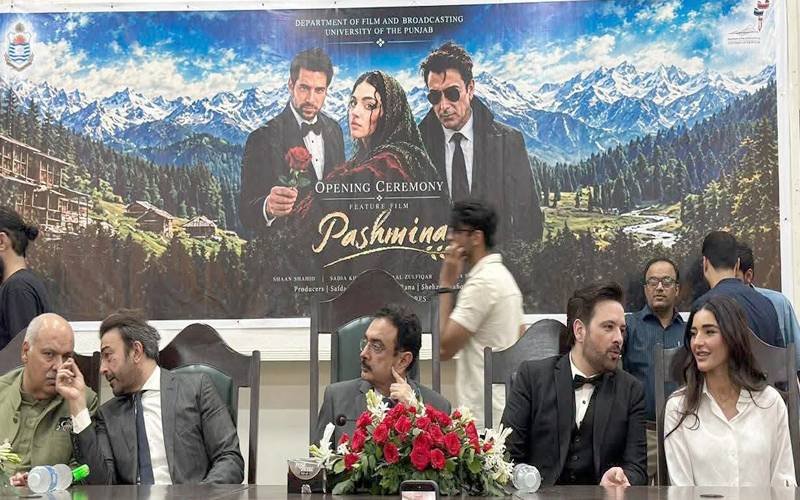
The ceremony was attended by University of the Punjab Vice Chancellor Professor Dr Muhammad Ali Shah as the chief guest. The film’s leading cast includes Shan Shahid, Mikaal Zulfiqar, Sadia Khan and Hira Somro.
Other notable attendees included veteran filmmaker Syed Noor, Pakistan Film Producers Association Chairman Mian Amjad Farzand, producer Safdar Malik, screenwriters Muhammad Pervaiz Kaleem and Nasir Adeeb, director Masood Butt, senior actor Rashid Mahmood, former actress Gori, Iftikhar Ahmed Afi, Naeem Wazir, Punjab University Film and TV Broadcasting Department Chairperson Dr Lubna Zaheer, playwright Aamna Mufti and Thakur Lahori.
Speaking at the event, Shahzad Rafique said Pashmina is a cinematic adaptation of Tess of the d’Urbervilles, the acclaimed novel by 19th-century English writer Thomas Hardy.
He said the novel explores social injustice, class divisions, women’s dignity, societal double standards and human self-respect — themes that remain relevant today. Adapting the story within Pakistan’s social and cultural context, he added, was both a creative undertaking and an intellectual responsibility.
Hardy’s novel follows Tess, a poor young woman living in rural 19th-century England. After her family discovers a supposed connection to an affluent and respected lineage, Tess is sent to a wealthy family in the hope of improving their financial circumstances.
There, she encounters Alec d’Urberville, whose exploitative behaviour sets off a series of hardships in her life. Tess later finds work on a dairy farm and falls in love with Angel Clare, whom she marries. However, when she reveals her past, Angel struggles to accept it and leaves her, forcing Tess to endure poverty, social condemnation and isolation.
Angel eventually realises his mistake and returns, but by then circumstances have changed dramatically, leading the story towards a tragic conclusion.
The novel is widely recognised not merely as a tale of love and loss, but also as a critique of a society that often blames victims rather than understanding the circumstances they face.
Through Pashmina, Rafique aims to bring these enduring themes into a Pakistani setting, highlighting questions of social justice, class inequality, women's dignity and the double standards that continue to shape society.