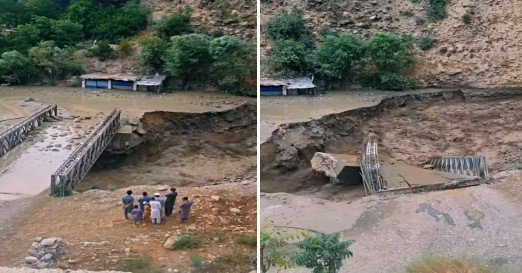
Natural disasters have long tested the resilience of civilizations, serving as stark reminders of nature’s immense power and humanity’s profound fragility. Yet, in the modern era, the nature of these disasters has undergone a fundamental shift. What were once perceived as unpredictable seasonal anomalies have increasingly transformed into human-induced climate crises, driven by accelerated planetary warming and ecological imbalance. Nowhere is this transformation more evident today than across Pakistan’s northern frontier, where the high-altitude valleys of Khyber Pakhtunkhwa and Gilgit-Baltistan face an existential threat borne of melting glaciers and relentless cloudbursts.
From Chitral to the high passes of Gilgit-Baltistan, floods driven by glacial melt and intense rainfall have caused widespread devastation. In Lower Chitral, Glacial Lake Outburst Floods (GLOFs) have damaged communities in Sheshi Koh Valley, Drosh, Gumbas Gol, Broz, and Karimabad Valley. Further north, the swollen Chitral River and mountain streams have swept through Reshun, Zait, Kuragh, Charun, Booni, Awi, Parwak, Mastuj Khas, Parkusap, Sonughure, and remote border hamlets like Yarkhun Lasht. At Kuragh, the main arterial highway was washed into the river, marooning thousands of residents.
The crisis extends across the regional border into Gilgit-Baltistan, where the 2025 monsoon brought a succession of flash floods, cloudbursts, landslides and GLOF-related hazards. The provincial government declared 37 areas across Diamer, Gilgit, Ghizer, Skardu, Shigar, Ghanche, Nagar and Kharmang as calamity-hit. In Ghizer, flooding damaged settlements and agricultural land and disrupted the Ghizer-Shandur Road, while later in August a massive mudslide blocked the Ghizer River, creating a roughly seven-kilometre-long lake and threatening downstream communities in Ghizer, Gilgit, Astore and Diamer. In Hunza, flooding and damage to irrigation infrastructure were reported in Gojal, while across Skardu, Shigar, Ghanche and Kharmang, floods and landslides damaged bridges, roads, homes and agricultural land. NDMA’s post-monsoon assessment recorded hundreds of damaged houses and dozens of damaged bridges across the region, underscoring the vulnerability of mountain communities and infrastructure to increasingly compound climate hazards.
Yet, amid this widespread emergency, a troubling socio-cultural paradox grips the region. Instead of confronting the scientific and structural realities of these mega-disasters, public discourse is frequently derailed by deeply ingrained superstitions, moralizing, and mutual finger-pointing. When a mountain nullah bursts or a glacier collapses, a common refrain among community members is to attribute the tragedy to divine retribution for alleged social misconduct, improper behavior or ideological deviance. Neighbors quickly turn on neighbors, judging personal choices and attributing physical climate catastrophes to perceived moral decay.
This retreat into fatalism and interpersonal judgement serve as a psychological shield, relieving communities of the duty to demand environmental accountability, build resilient infrastructure, and adapt to climate change. As the renowned physicist Richard Feynman famously remarked:
“Reality must take precedence over public relations, for Nature cannot be fooled.”
Nature cannot be appeased by moralistic scapegoating when the physics of thermal dynamics are at play.