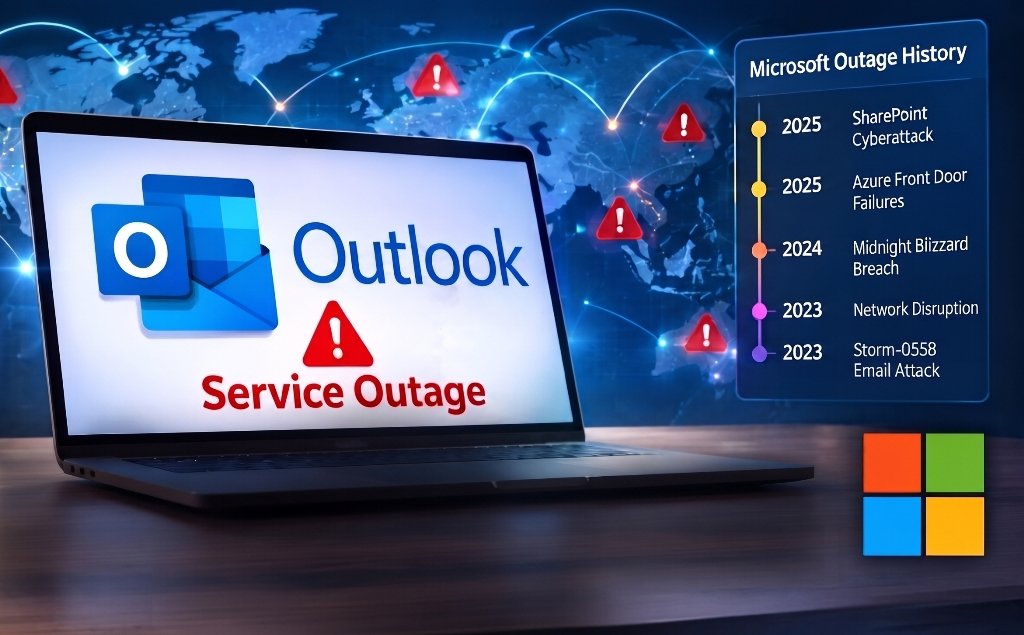
Reports surged to nearly 130,000 Outlook problems on Downdetector shortly after 1 p.m. Eastern time. Users reported problems opening inboxes and sending or receiving emails. But today's outage is more useful as a case study than as another short-lived service alert.
Microsoft has experienced several major cloud and software disruptions in recent years. The company has also faced serious cyberattacks, including incidents involving government email accounts and Microsoft’s own corporate systems.
Those events had very different causes. That distinction matters because a Microsoft outage does not automatically mean Microsoft was hacked.
What happened to Microsoft Outlook today?
Microsoft confirmed an incident affecting Exchange Online, the cloud email infrastructure used by Outlook and Microsoft 365 customers.
The incident is tracked as EX1550543. Microsoft said users could have trouble connecting to their mailboxes through multiple connection methods, including Outlook on the web and other Exchange interfaces.
Microsoft initially said it was investigating the problem. Later updates pointed to failed health checks and an overwhelmed server component. Microsoft began testing recovery measures and shifting traffic across its infrastructure.
At its peak, Downdetector recorded nearly 130,000 Outlook reports. The number later declined, although many users continued reporting problems.
Is the Microsoft outage a cyberattack?
There is no confirmed evidence that today's outage was caused by hackers. Microsoft's public explanation has focused on infrastructure, server health checks, connectivity and capacity problems.
That is important because Microsoft has experienced genuine cyberattacks in the past. Those incidents should not be confused with today's service disruption.
A technical failure can make millions of users appear to lose access simultaneously without an attacker being involved.
Also Read: Jensen Huang Affair Puts Nvidia Under FBI Probe, China Scrutiny
Microsoft's outage history shows a bigger pattern
Today's incident is not the first time a failure inside Microsoft's infrastructure has disrupted multiple products. Microsoft operates a huge interconnected cloud ecosystem. Outlook, Teams, SharePoint, OneDrive, Azure and other services depend on layers of shared infrastructure.
When one critical component fails, the consequences can extend far beyond the original system. Microsoft's own published service-health data shows how high its overall availability remains despite those incidents. Microsoft 365 reported worldwide uptime of 99.988% in 2025 and 99.99% in 2023.
But high annual uptime does not eliminate the impact of a major outage. For a company relying on Microsoft 365 for business email, even an hour of disruption can matter.
January 2023: A Microsoft network problem disrupted multiple services
One of Microsoft's most significant recent service disruptions occurred on January 25, 2023. The incident affected several Microsoft 365 services, including Teams, Exchange Online, Outlook, SharePoint Online, OneDrive for Business and Microsoft Graph.
Microsoft identified a potential networking problem during the incident. Independent network analysis from ThousandEyes found that an external BGP change triggered widespread routing instability.
The disruption caused significant packet loss and affected connectivity to Microsoft services around the world. The bulk of the incident lasted about 90 minutes, although some residual problems continued afterward.
The lesson was significant. A problem at the network-routing layer can disrupt applications that appear completely unrelated to the underlying infrastructure.
July 2023: Microsoft faced a major email security breach
A year of outages is not the same thing as a year of cyberattacks. Microsoft also faced a serious security incident in 2023 involving Storm-0558, a China-based threat actor.
Microsoft said the actor forged authentication tokens to access customer email. The company identified approximately 25 affected organizations, including government agencies.
Microsoft said the attackers used an acquired Microsoft account signing key and exploited a token-validation issue to access enterprise email.
The company later invalidated the key and blocked the attacker's access. This incident demonstrates why the question “Was Microsoft hacked?” requires a specific answer.
Sometimes the answer is yes. But a service outage by itself does not establish a hack.
January 2024: Russian hackers breached Microsoft's corporate email
Microsoft disclosed another major security incident in January 2024. The company said the Russian state-sponsored group Midnight Blizzard, also known as Nobelium, gained access to a legacy non-production test account through a password-spray attack.
The attackers then accessed a small percentage of Microsoft corporate email accounts, including accounts belonging to senior leaders and employees working in cybersecurity and legal functions. Microsoft said some emails and attached documents were exfiltrated.
This was a confirmed security breach. It was fundamentally different from a cloud-service outage.
The distinction is important for users trying to understand whether today's Outlook disruption represents a security threat.
July 2024: The global IT crash had a different cause
Another event often associated with Microsoft was the massive global IT disruption on July 19, 2024. But it was not simply a Microsoft outage. The incident was linked to a faulty update from cybersecurity company CrowdStrike that affected Windows systems around the world.
Microsoft services were affected in some environments, but attributing the entire global incident to Microsoft's own infrastructure would be misleading.
Microsoft community documentation later described a separate Microsoft 365 disruption in July 2024 involving an Azure backend configuration change that caused connectivity failures for downstream Microsoft 365 services.
The broader lesson was clear: modern digital infrastructure is interconnected. A failure at one company can create consequences across airlines, banks, businesses, hospitals and government services.
July 2025: Microsoft SharePoint faced an active cyberattack
Microsoft also dealt with a very different kind of problem in July 2025. Attackers actively exploited vulnerabilities in on-premises SharePoint Server.
Microsoft identified vulnerabilities including CVE-2025-49706 and CVE-2025-49704 and later reported attacks involving the threat actor Storm-2603.
Microsoft stressed an important distinction: the vulnerabilities affected on-premises SharePoint Server, not SharePoint Online in Microsoft 365.
That distinction again shows why headlines about “Microsoft being hacked” can be misleading. A vulnerability in a particular product or deployment model does not mean Microsoft's entire cloud platform was compromised.
October 2025: Azure Front Door failures exposed cloud dependency risks
Microsoft experienced another major infrastructure problem in October 2025 involving Azure Front Door. Microsoft later published an analysis of two incidents on October 9 and October 29.
The company said configuration problems caused incompatible metadata to propagate through parts of its infrastructure. The October 29 incident affected connectivity and DNS resolution for applications using the platform.
The incidents affected Microsoft services and customers using Azure Front Door. Microsoft subsequently described changes designed to improve configuration safety, recovery times and tenant isolation.
This is one of the most important pieces of context for today's Outlook outage. The issue is not simply whether Microsoft has enough servers.
It is whether complex changes can safely move through a global system without turning a local problem into a widespread failure.
What today's Outlook outage has in common with previous incidents
The causes have varied. Some Microsoft disruptions came from network problems. Others involved configuration failures, infrastructure defects or problems with service components.
Separate incidents involved genuine cyberattacks. That makes one conclusion difficult to avoid:
Microsoft's outage history is not one story. It is several different reliability and security stories involving a highly complex technology ecosystem.
Today's Exchange Online incident appears, based on Microsoft's current explanation, to belong to the service-reliability category rather than the confirmed cyberattack category.
Why Microsoft outages affect so many people
Microsoft 365 is deeply embedded in workplace communication. Outlook handles email and calendars. Teams supports workplace collaboration. OneDrive and SharePoint support document storage and collaboration.
Those services can also connect with external applications and business systems. That creates a multiplier effect. When one major service fails, the impact can spread beyond users who directly subscribe to that service.
The January 2023 network disruption illustrated this clearly. Microsoft services across multiple product categories became inaccessible because of problems lower in the network stack.
Does today's outage mean Microsoft is becoming less reliable?
Not necessarily. Microsoft's published uptime figures remain extremely high. But uptime percentages can hide an important reality for customers.
A service operating at 99.99% availability can still experience incidents that affect millions of users at the same time.
For a business, the question is therefore not only “How often does Microsoft go down?”
It is also:
“What happens to our business when Microsoft does go down?”
That is a resilience question. Businesses that depend entirely on one cloud provider for email, collaboration and identity may have limited options during a major incident.
What should Outlook users do now?
Users experiencing problems should first determine whether the issue is widespread. If Microsoft confirms an Exchange Online outage, repeatedly changing passwords or reinstalling Outlook is unlikely to solve the underlying problem.
Users should monitor Microsoft's official service updates and wait for the company to restore affected infrastructure.
Microsoft says customers can receive service-incident information through the Microsoft 365 admin center. Its service-health documentation also provides information about monitoring incidents and availability.
For businesses, today's outage is also a reminder to maintain backup communication channels.
Where can users check Microsoft's outage status?
The most authoritative source is Microsoft's service-status infrastructure. Microsoft 365 service health and continuity information
Microsoft also provides cloud status information through its service-status systems. For today's incident, the tracking identifier is EX1550543.
Users can also use outage-reporting services such as Downdetector to determine whether other customers are experiencing similar problems.
However, user reports should be treated as an indicator of disruption, not as an exact count of affected customers.
The bigger lesson from Microsoft's outage history
Today's Outlook outage will eventually be resolved. The more important question is what Microsoft and its customers learn from it.
Microsoft has repeatedly faced different types of technology failures and security incidents. The company has also published post-incident reviews and engineering changes after major disruptions.
The history shows that cloud reliability is not simply about preventing every failure.
It is about limiting the blast radius, detecting problems quickly and restoring service before a localized failure becomes a global one.
That is why today's outage deserves attention beyond the immediate question of whether Outlook is working. It is another test of how resilient one of the world's most widely used digital infrastructure platforms can be.
FAQs
Is Microsoft Outlook down today?
Yes. Microsoft confirmed an Exchange Online incident affecting users' ability to connect to mailboxes through multiple connection methods. Penn Mail Services
Is today's Microsoft outage a cyberattack?
There is currently no confirmed evidence that today's outage was caused by a cyberattack. Microsoft's investigation has focused on infrastructure, health checks, server capacity and connectivity. AP News
Has Microsoft been hacked before?
Yes. Microsoft has disclosed several major security incidents, including the Storm-0558 email attack in 2023 and the Midnight Blizzard breach of Microsoft corporate email in 2024. Microsoft
What was the major Microsoft outage in 2023?
A January 2023 network disruption affected multiple Microsoft 365 services, including Outlook, Teams, Exchange Online, SharePoint and OneDrive. Independent network analysis linked the disruption to BGP routing changes. ThousandEyes
What happened to Microsoft in 2025?
Microsoft experienced significant Azure infrastructure incidents in 2025, including Azure Front Door disruptions. Microsoft also responded to active attacks against on-premises SharePoint vulnerabilities. These were separate incidents with different causes. TECHCOMMUNITY.MICROSOFT.COM
Does a Microsoft outage mean my emails are lost?
Not necessarily. Today's confirmed problem concerns access to Exchange Online mailboxes. There is currently no evidence that the outage itself means users' stored emails have been deleted.
How can I check Microsoft's outage status?
Microsoft's service-health system is the primary source for customers. Users can also monitor Microsoft's public service-status updates and outage-reporting platforms.