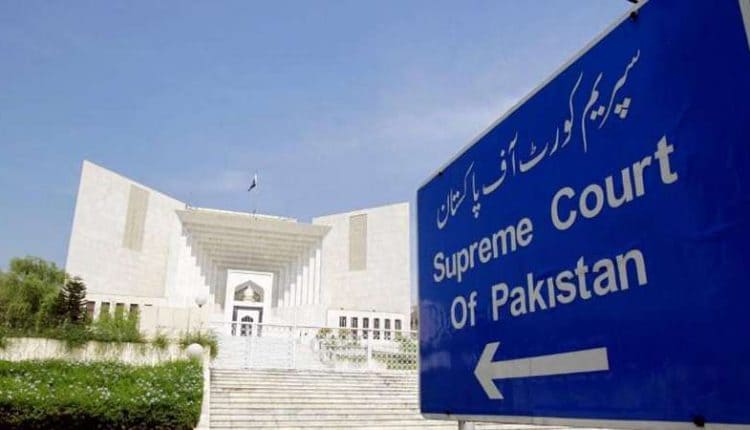
ISLAMABAD: The Supreme Court has clarified that child maintenance must be determined by considering the reasonable needs of the minor, the father’s financial capacity and income, as well as his social status.
The court also held that a maintenance amount fixed by a lower court should only be altered if the decision is clearly arbitrary, unreasonable or contrary to law.
A two-member bench comprising Justice Irfan Saadat Khan and Justice Aqeel Ahmad Abbasi dismissed a petition seeking leave to appeal filed by Shaheen Nawaz and upheld the Sindh High Court’s decision.
The petitioner had argued that the child’s father worked as a manager at a textile company in Bangladesh and earned a good salary. She sought an increase in the child’s monthly maintenance to Rs40,000.
According to the Supreme Court’s detailed judgment, a Family Court had initially determined the child’s maintenance, while the District Judge later fixed it at Rs30,000 per month, with a 15% annual increase. The Sindh High Court subsequently upheld that decision.
The Supreme Court observed that the appellate court and the High Court had carefully considered the father’s income, financial resources, other support obligations and the child’s needs before determining the maintenance amount.
The court also noted that the father was responsible for supporting two other children from his first marriage.
Referring to its recent judgment in Muhammad Imran Baqir v. Mst Zarneen Arzo (PLD 2026 SC 170), the Supreme Court reiterated that providing for one’s children is both a legal and moral responsibility of the father. However, the amount of maintenance must be assessed in light of the child’s genuine needs and the father’s financial means.
The bench found that the petitioner had failed to establish any legal defect, improper assessment of evidence or misuse of jurisdiction by the lower courts that would justify Supreme Court intervention.
The court therefore declined to interfere under Article 185(3) of the Constitution and dismissed the petition seeking leave to appeal, leaving the Sindh High Court’s decision intact.