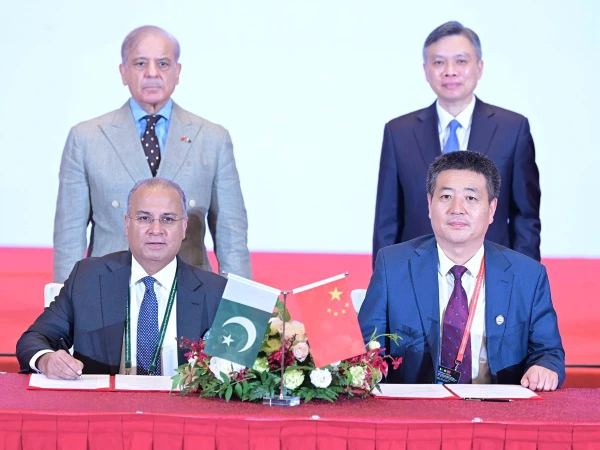
BEIJING: Pakistan and China have signed investment agreements worth more than $7 billion, as Prime Minister Shehbaz Sharif invited Chinese investors to expand operations in Pakistan and relocate industries to the country, offering full facilitation in a special economic zone in Karachi.
Prime Minister Sharif is currently on an official visit to China, during which companies from both countries signed multiple agreements and memorandums of understanding (MoUs) to promote cooperation and investment across various sectors.
Addressing the Pakistan-China Business-to-Business Investment Conference in Hangzhou, the Prime Minister invited Chinese investors to invest in agriculture, IT, special economic zones, mining, and mineral resources.
He stated that Pakistan does not seek loans and aid, but rather investment, expertise, and joint development, adding that it is essential to convert billions of dollars worth of MoUs into concrete agreements.
The Prime Minister said that investors in the Karachi Special Economic Zone will be provided world-class facilities, a one-window operation, and long-term land leases.
He further noted that more than 200 MoUs worth over $20 billion have been signed during five Pakistan-China B2B conferences so far, with around 30 percent already converted into formal agreements.
During the conference, several major deals were signed, including a $1.12 billion agreement between Hualu Engineering & Technology Company Limited and Fauji Fertilizer for fertilizer production. Another $100 million MoU was signed between IBIB Beijing United Information Technology Company and RIC for agrochemicals, agricultural machinery, and the establishment of a regional office in Multan.
The Prime Minister also highlighted Pakistan’s agricultural potential, stating that China imports around $100 billion worth of agricultural products annually, but Pakistan’s share remains minimal. He said that with modern farming techniques, high-quality seeds, and mechanized agriculture, Pakistan could export up to $10 billion worth of agricultural products to China within the next five to seven years.
He added that Pakistan’s young population has strong potential in IT and artificial intelligence, and that Chinese investment in special economic zones would benefit both countries.
Inviting Chinese companies to relocate their industries to Pakistan, the Prime Minister said joint ventures and export-oriented production would strengthen economic ties.
He described Chinese President Xi Jinping as a visionary leader who transformed China into a global economic and military power, and said that Pakistan and China’s friendship is “deeper than the ocean and higher than the Himalayas.”
Federal Minister for IT Shaza Fatima Khawaja, speaking at the conference, said that CPEC 2.0 is no longer limited to infrastructure development but is evolving into a “Digital Silk Road,” covering fiber optics, artificial intelligence, semiconductors, e-commerce, and IT cooperation.
The conference was attended by Deputy Prime Minister and Foreign Minister Ishaq Dar, federal ministers, Pakistani and Chinese investors, business leaders, and representatives from various companies.