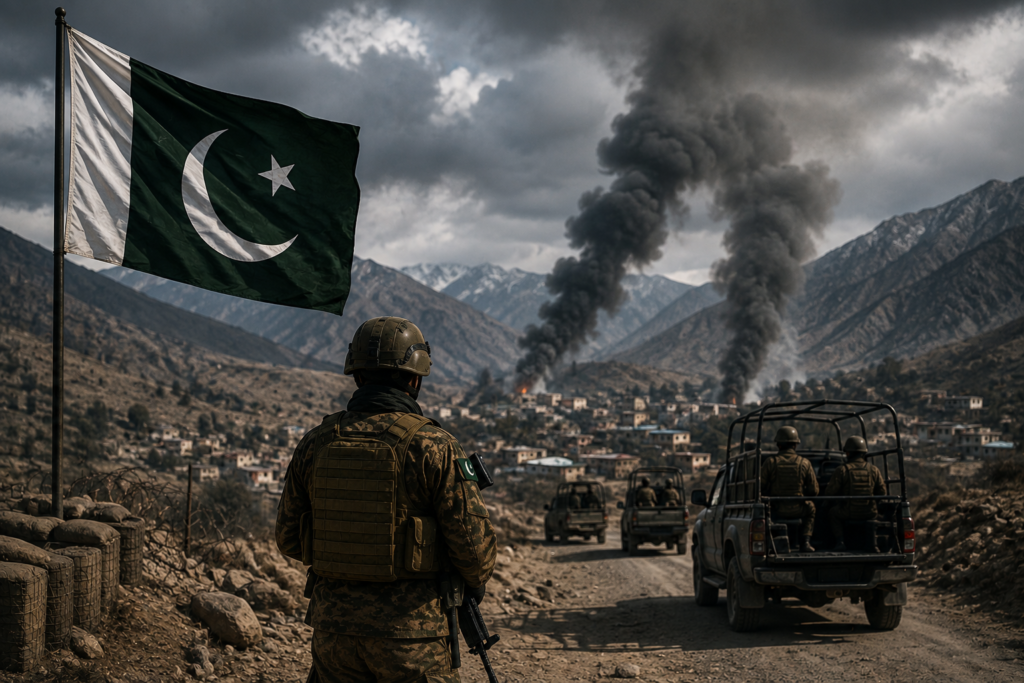
Pakistan terrorism has reached a critical point, with the country topping the Global Terrorism Index for the first time in recent years.
The Global Terrorism Index 2026 recorded 1,139 terrorism-related deaths in Pakistan. It also recorded 1,045 incidents during 2025.
The Institute for Economics and Peace compiled the index using data from the previous year. Tehrik-i-Taliban Pakistan and Balochistan Liberation Army activity drove much of the violence.
Pakistan’s latest operational data shows that the crisis has continued into 2026. Security officials recorded thousands of attacks during the year’s first seven months.
Violence reaches new levels
Pakistan recorded 3,145 terrorism incidents between January and July, according to military officials.
Khyber Pakhtunkhwa recorded 1,971 incidents, while Balochistan reported 1,148. Authorities recorded the remaining 26 incidents elsewhere in the country.
The violence killed 819 people, including 303 army personnel. Police and other law-enforcement agencies lost 194 personnel during the same period.
Security forces conducted more than 40,000 intelligence-based operations. Officials said those operations killed more than 2,000 militants.
July proved particularly deadly. The Pakistan Institute for Conflict and Security Studies recorded 606 deaths linked to militant violence and counter-terrorism operations.
Security-force deaths jumped 195 per cent from June. The toll rose from 38 deaths in June to 112 in July.
That marked the highest monthly security-force death toll since January 2023. It also ranked among the highest monthly totals recorded in more than a decade.
Suicide attacks add to pressure
Militant deaths also surged in July. PICSS recorded 401 militant fatalities, a 109 per cent increase from June.
Civilian deaths rose 21 per cent, reaching 74 during the month. At least eight suicide attacks also occurred across Pakistan.
Five involved vehicle-borne improvised explosive devices. That represented the highest monthly number of such attacks in a decade.
Balochistan suffered the sharpest deterioration. Overall deaths there increased by 241 per cent during July.
The violence has also intensified across the first seven months of 2026. PICSS recorded 2,786 deaths linked to militant violence and counter-operations.
The toll included 1,857 militants, 463 civilians and 434 security personnel. Pro-government peace committees also lost 32 members.
Afghanistan remains a major security concern
The pattern suggests a sustained escalation rather than a temporary spike. Security-force and civilian fatalities have both increased compared with 2025.
The tactical profile has also evolved. Militants increasingly use vehicle-borne explosives against checkpoints, convoys and security installations.
TTP networks remain active in the northwest. BLA factions have continued attacks across Balochistan.
Pakistan’s security challenge also reflects developments following the US and NATO withdrawal from Afghanistan in 2021.
The Taliban takeover created opportunities for TTP networks to rebuild recruitment and logistical capabilities. Cross-border movement also remained a persistent concern along the Durand Line.
Islamabad has repeatedly accused Afghan authorities of allowing militant sanctuaries. Kabul has rejected allegations of systematic support for attacks inside Pakistan.
Border fencing and military pressure have produced tactical gains. They have not, however, eliminated the wider security challenge.
A widening regional security challenge
The May 2025 military confrontation with India further complicated Pakistan’s security environment.
The four-day conflict ended with a ceasefire. It also intensified concerns about unconventional and asymmetric competition between the two nuclear-armed neighbours.
Pakistani officials have linked parts of the militant violence to Indian support. Islamabad has also presented evidence of Indian state involvement in terror activities in Balochistan to international bodies. Pakistan has cited the arrest and subsequent statements of Indian naval officer Kulbhushan Jadhav in support of its allegations.
Meanwhile, Pakistan’s internal security crisis has received limited sustained international attention. Larger conflicts across the Middle East have dominated global coverage.
Yet the scale of Pakistan’s violence presents a serious security challenge. The concentration of attacks in KP and Balochistan exposes persistent weaknesses beyond battlefield operations.
Military operations can disrupt militant networks. They cannot alone resolve the political, economic and governance conditions that sustain insurgencies.
Pakistan’s 2026 trajectory therefore carries significant risks. Continued violence could increase pressure on security forces, civilians and already fragile provincial institutions.
Long-term improvement will require stronger border management and effective local governance. It will also require sustained regional diplomacy against militant sanctuaries and support networks.