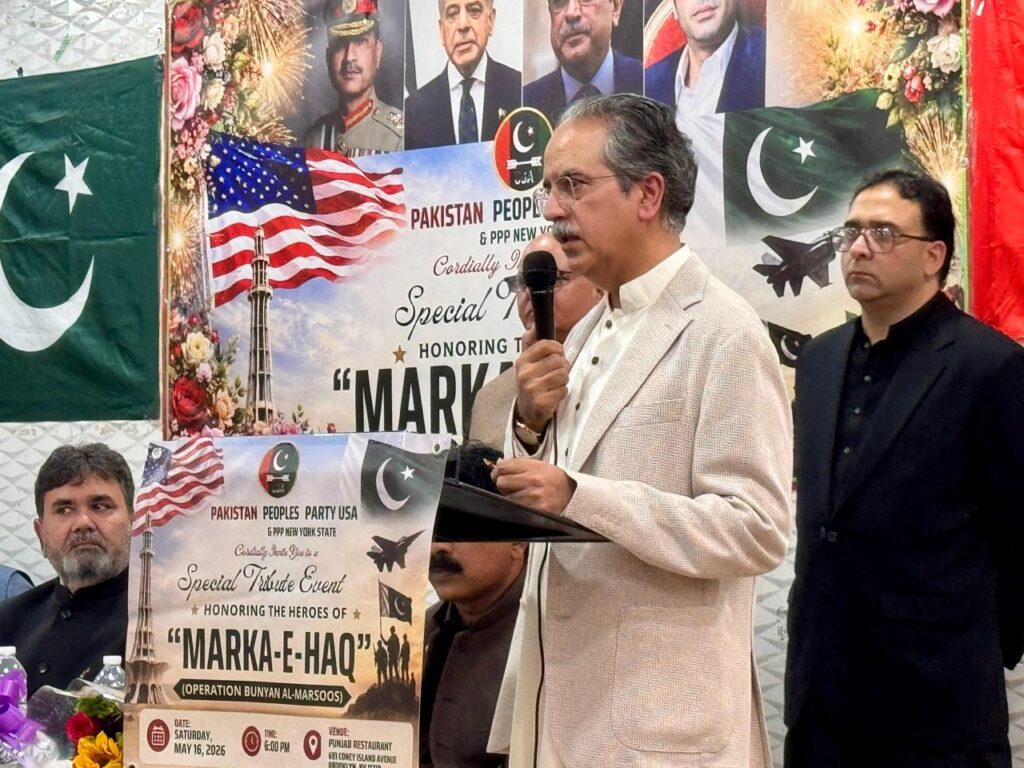
NEW YORK: Ambassador Asim Iftikhar Ahmad, Pakistan’s Permanent Representative to the United Nations, has said that the true character of nations is judged during moments of crisis. He noted that Marka-e-Haq demonstrated the collective determination of the Pakistani nation, which stood shoulder to shoulder with its armed forces in defending the motherland against Indian aggression.
He paid rich tribute to the people of Pakistan, the country’s political and military leadership, and the armed forces for their steadfast unity and resolve during Marka-e-Haq.
Addressing a community event in Brooklyn held to commemorate the historic Marka-e-Haq, Ambassador Asim said that Pakistan’s military success was transformed into a major political and diplomatic success through effective statecraft and principled diplomacy.
He underscored that Pakistan presented a truth-based narrative before the international community, which found resonance in world capitals and across international media platforms.
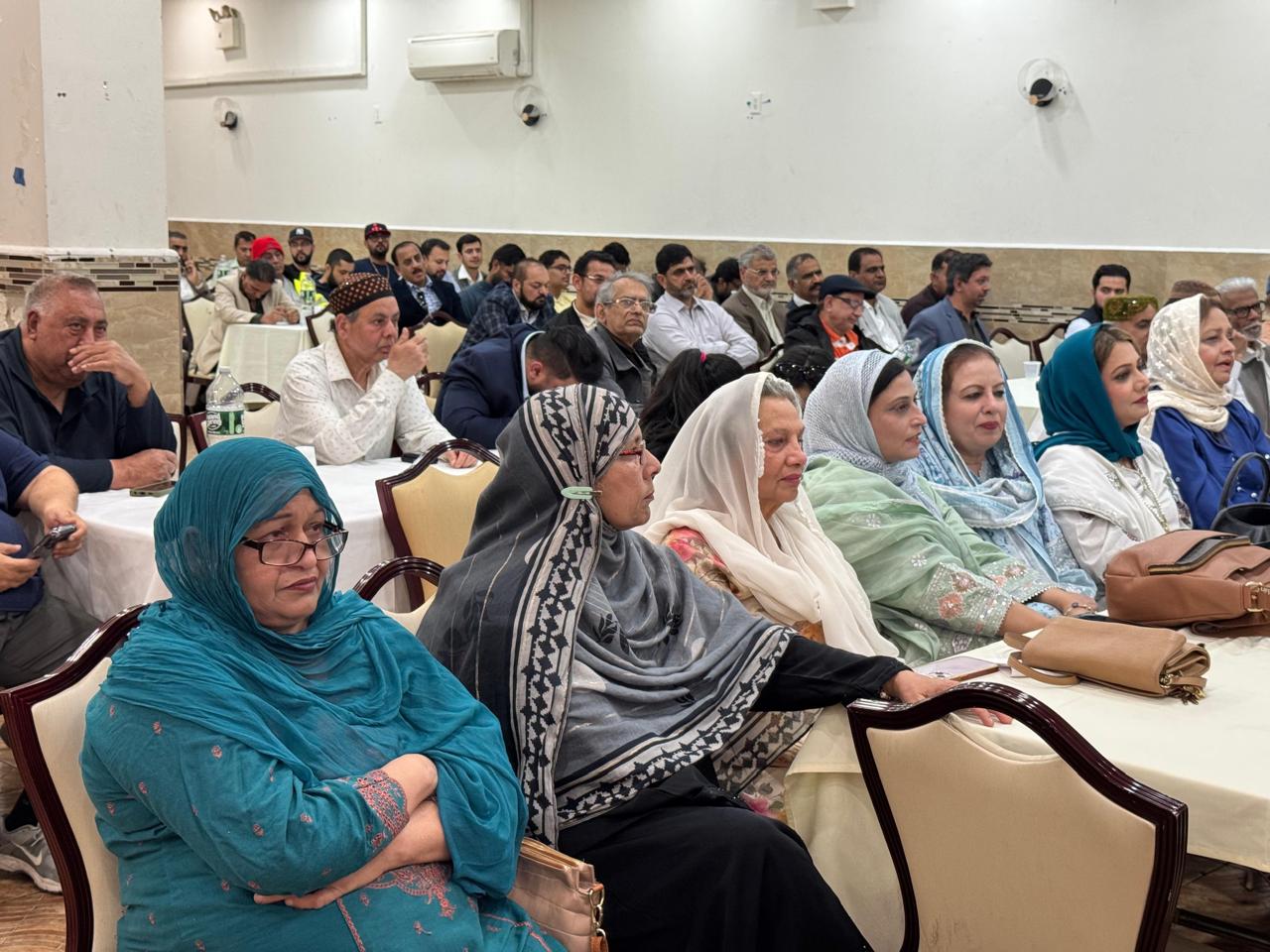
The event was organized by prominent community leader Malik Khalid Awan, which was attended by the members of Pakistani community belonging to different fields of life. Senator Rana Mahmood ul Hassan also spoke on the occasion.
Referring to Pakistan’s diplomatic outreach following the conflict, Ambassador Asim highlighted the visit of the high-level parliamentary delegation led by Bilawal Bhutto Zardari, undertaken on the directions of the Prime Minister.
The delegation, he said, engaged extensively with the United Nations leadership, including the Secretary-General, the President of the General Assembly, the President of the Security Council, representatives of the Organization of Islamic Cooperation, and ambassadors of Security Council member states to effectively articulate Pakistan’s position on the conflict with India.
In contrast, he noted, the Indian delegation present in New York during the same period refrained from engaging at the United Nations.
Ambassador Asim emphasized that despite prevailing tensions and Pakistan’s success in the conflict, the country consistently advocated peace, dialogue, and diplomacy.
 He pointed to Pakistan’s presidency of the United Nations Security Council in July, during which it spearheaded the adoption of the resolution titled “Peaceful Settlement of Disputes” at a time when the Council remained deeply divided on several international issues.
He stressed, however, that while Pakistan believes in peaceful coexistence and negotiated solutions, the country remains fully prepared to defend its sovereignty and territorial integrity against any aggression. He cautioned that India continues to hatch conspiracies against Pakistan and that the challenges facing the region persist.
The Ambassador further noted that the strengthening of Pakistan’s international partnerships, including the Pakistan-Saudi Arabia defence agreement, reflected growing global recognition of Pakistan’s strategic importance and diplomatic success following the conflict.
Underscoring Pakistan’s active role at the United Nations, Ambassador Asim said Pakistan continues to strongly advocate for the peoples of Indian Illegally Occupied Jammu and Kashmir and Palestine. He added that Pakistan was also among a group of eight countries that worked closely with President Donald Trump and his administration to help secure a ceasefire in Gaza.
Concluding his remarks, Ambassador Asim Iftikhar Ahmad called upon Pakistanis, both individually and collectively, to continue serving and safeguarding the national interest and to strive to bring greater laurels to the motherland.
In his remarks on the occasion, Senator Rana Mahmood ul Hassan paid tribute to Pakistan’s armed forces, political leadership, and diplomatic corps for their exemplary role during Marka-e-Haq.
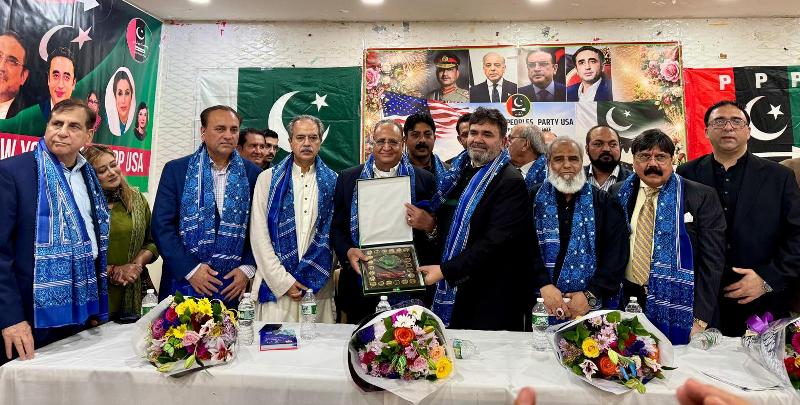
The Senator said that nations are rarely presented with defining moments such as Marka-e-Haq, which reshape their destiny and determine their standing in the comity of nations. He noted that during this critical period, Pakistan’s military and political leadership rose to the expectations of the people and made the entire nation proud through courage, unity, and strategic clarity.
Paying special tribute to Pakistan’s diplomats, Senator Rana Mahmood ul Hassan said that Pakistani diplomats, particularly Ambassador Asim Iftikhar Ahmad, played a vital role in winning the war of ideas and narratives at the international level.
He commended Ambassador Asim for leading Pakistan’s Mission to the United Nations in a highly proactive manner during the conflict with India and effectively articulating Pakistan’s principled position before the international community.
The Senator emphasized that Pakistan’s diplomatic success was the result of a collective national effort involving political leadership, diplomats, armed forces, media, and the people of Pakistan.
Referring to the evolving regional security environment, Senator Rana Mahmood ul Hassan observed that recent history has demonstrated that nations lacking strong defence capabilities remain vulnerable to external aggression and hostile designs. He stressed that Pakistan’s preparedness and national resolve served as a powerful deterrent against aggression.
Highlighting the longstanding dispute over Jammu and Kashmir, the Senator said the unresolved Kashmir issue remains the root cause of instability and recurring tensions in South Asia. He reiterated Pakistan’s unwavering political, diplomatic, and moral support for the Kashmiri people’s right to self-determination in accordance with relevant United Nations resolutions.
The Senator further stated that India continues to employ proxies and terrorist organizations, including Tehreek-e-Taliban Pakistan and Balochistan Liberation Army, to destabilize and bleed Pakistan. He underscored the need to expose such machinations at the global level and to defend Pakistan’s interests on all fronts — diplomatic, political, informational, and military.
Those who spoke on the occasion included Dr. Ghulam Mujtaba, Malik Khalid Awan, Attiya Sheraz, Javed Chaudhry, Rohail Dar, Mian Azeem, Safdar Gujjar, Nighat Farooq, Azra Dar, and Iqbal Khokhar etc.