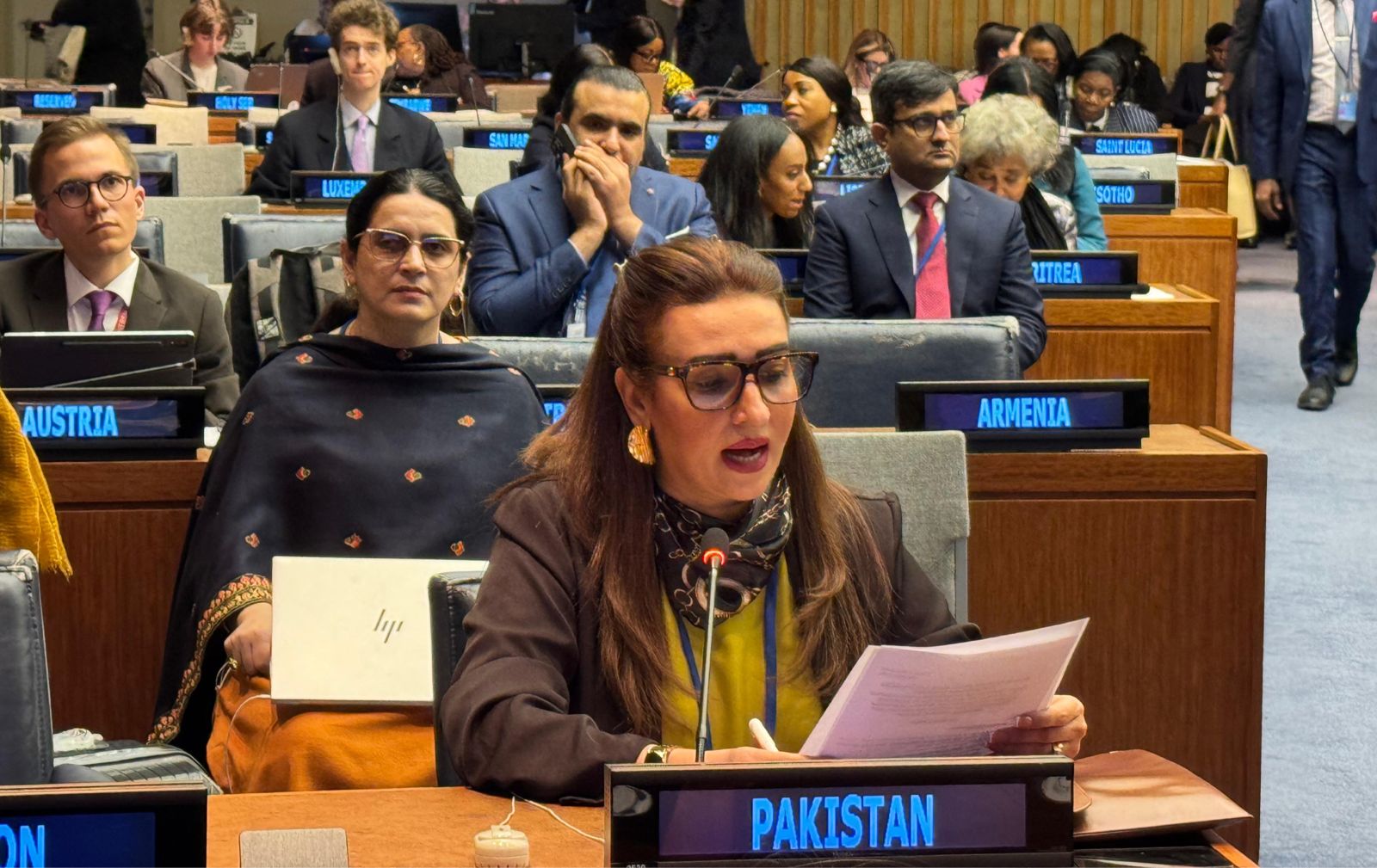
UNITED NATIONS: Senator Bushra Anjum Butt has said that access to justice for women and girls must be measured not simply by the existence of laws, but by whether discrimination and structural barriers allow women to use those laws in practice.
Delivering remarks during the first ministerial roundtable on “Ensuring and strengthening access to justice for all women and girls”, Senator Butt said the real test of justice comes when discrimination determines who can reach legal protection.
She noted that for millions of women and girls worldwide, justice is obstructed not only by legal gaps but also by entrenched social, economic and institutional discrimination.
She is in New York to participate in the ongoing 70th Session of the Commission on the Status of Women as head of the Pakistani delegation.
Highlighting the multiple barriers women face, the Senator pointed to inequality in inheritance, restrictions on mobility, exclusion from financial systems, workplace harassment, harmful customary practices, and discriminatory treatment within institutions as factors that collectively shape whether justice is attainable or remains out of reach.
Senator Bushra Butt said Pakistan’s approach has, therefore, moved beyond legal reform alone toward addressing discrimination as a systemic obstacle to gender equality and women’s empowerment.
Grounded in constitutional guarantees of equality and dignity, she said Pakistan has been working to align its legislative framework with the lived realities of women and girls.
She noted that laws addressing honor crimes, forced marriage, workplace harassment, domestic violence and sexual offences are being implemented, as part of broader efforts to strengthen protections and improve access to justice.
Emphasizing that justice also depends on agency, Senator Butt said economic and educational empowerment are essential to enabling women to claim their rights. She highlighted initiatives such as the Benazir Income Support Programme, which she said has provided financial protection to millions of women and strengthened their economic empowerment.
She also cited education stipends, skills development programmes and digital inclusion initiatives aimed at expanding awareness of rights and building confidence to seek justice.
She further referred to financial inclusion policies, women’s employment quotas, entrepreneurship support and increasing representation in politics and other fields as measures contributing to gender equality and the empowerment of women and girls.
Senator Butt stressed that eliminating discrimination requires progress on three fronts: laws that protect, institutions that deliver and societies that enable. She called for sustained investment in legal literacy, enforcement capacity, and services for victims and survivors.
Concluding the statement, she said commitments should be judged by barriers removed rather than laws passed, stressing that justice becomes real only when every woman can stand before the law without fear or discrimination.