Mumtaz Hussain
UNITED NATIONS: Pakistan has urged the United Nations Security Council to take swift action against terrorist groups operating from Afghanistan and called for the designation of the Balochistan Liberation Army (BLA) under the UN’s 1267 sanctions regime.
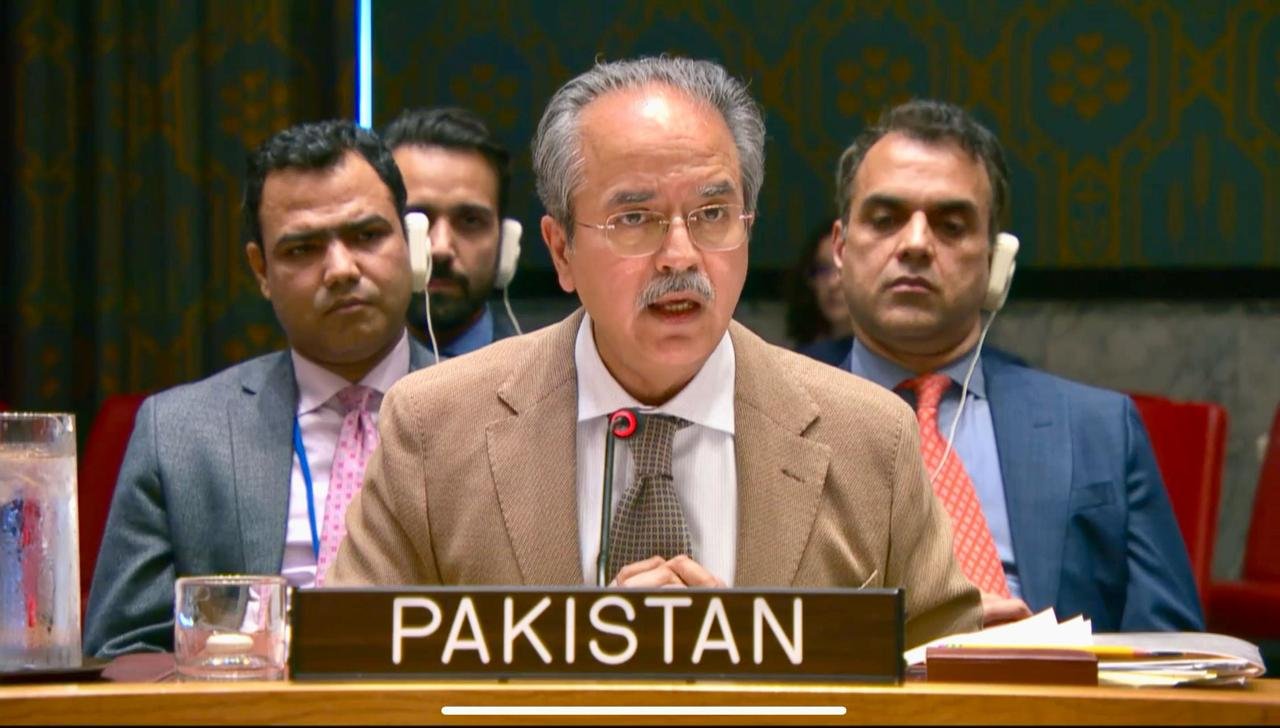
Addressing a Security Council briefing on “Threats to International Peace and Security caused by Terrorist Acts,” Pakistan’s Permanent Representative to the UN, Ambassador Asim Iftikhar Ahmad, condemned terrorism in all its forms and highlighted Pakistan’s long-standing role as a frontline state in global counter-terrorism efforts.
The ambassador said Pakistan had suffered more than 90,000 casualties and severe economic losses due to terrorism over the years. He recalled Pakistan’s role in dismantling Al-Qaida’s core in Afghanistan and its continued efforts to counter the Islamic State’s regional affiliate, ISIL-K.
Ambassador Ahmad warned that following the Taliban’s takeover of Kabul, what he described as externally sponsored and foreign-funded proxy groups, including Tehreek-i-Taliban Pakistan (TTP) and the BLA and its Majeed Brigade, had gained renewed momentum. He said these groups were operating from Afghan soil with impunity and were responsible for deadly attacks inside Pakistan.
Referring to recent violence in Balochistan province, the envoy said the BLA had claimed responsibility for a series of coordinated attacks that resulted in the deaths of 48 civilians, including women and children. He added that Pakistani security forces neutralised 145 militants in subsequent operations.
Pakistan called on the Security Council to approve its pending request to list the BLA under the UN’s counter-terrorism sanctions regime. The ambassador welcomed the Council’s press statement condemning the attacks and thanked member states for expressing solidarity with Pakistan.
The Pakistani envoy also raised concerns about the evolving global terrorism landscape, citing the growing threat posed by Da’esh across multiple regions, including Africa, the Middle East and South Asia. He noted the group’s use of modern technologies, digital financing methods, unmanned aerial systems and online platforms for recruitment and propaganda.
Ambassador Ahmad stressed the need for a collective and coordinated international response under the UN Global Counter-Terrorism Strategy. He said terrorist threats emanating from Afghanistan posed risks not only to Pakistan but to the wider region and beyond, and warned about advanced weapons left behind in the country falling into the hands of militant groups.
He further called for accountability for what he termed external actors supporting and financing terrorist groups, urged zero tolerance for state terrorism in situations of foreign occupation, and advocated for expanding UN counter-terrorism frameworks to address emerging threats, including far-right and extremist ideologies.
Concluding his remarks, the ambassador said terrorism could only be defeated through unity, cooperation and the elimination of double standards. He said the upcoming ninth review of the UN Global Counter-Terrorism Strategy provided an opportunity to strengthen international efforts against terrorism, and reaffirmed Pakistan’s commitment to multilateral cooperation to combat the threat.