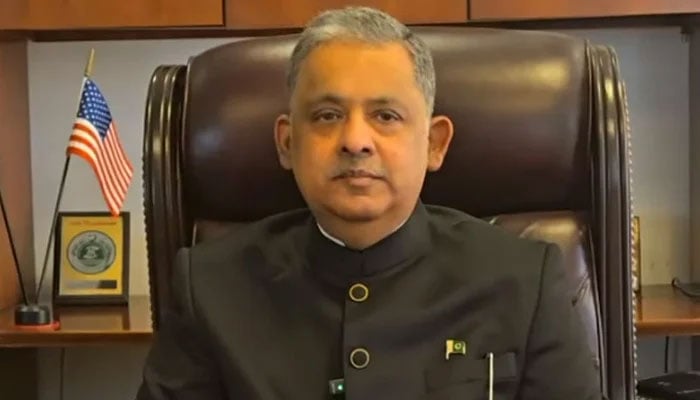
WASHINGTON: Pakistan’s Ambassador to the United States Rizwan Saeed Sheikh said his country seeks constructive engagement with major global powers while prioritizing regional stability, economic reform and counterterrorism.
He was addressing at Johns Hopkins University’s School of Advanced International Studies (SAIS) hosted under the Asia Policy and Career Roundtables Series on “Pakistan’s Global Engagement in a Changing World."
The ambassador discussed Pakistan–U.S. relations, ties with India, the situation in Afghanistan, relations with China, developments in Iran and the Middle East, and Pakistan’s participation in the UN-established Board of Peace.
Mr Sheikh said Pakistan has borne the burden of instability and terrorism emanating from Afghanistan for decades, adding that the intensity and scale of such incidents have increased in recent months.
Referring to terrorist attacks over the past six months, he said the fingerprints behind them were, in Pakistan’s assessment, clear and beyond doubt. He noted that Pakistan had expected Afghanistan’s interim administration to uphold commitments under the Doha Agreement and prevent Afghan territory from being used for terrorism.
While emphasizing that Pakistan had exercised restraint, he stressed that the protection of its citizens’ lives and property remains paramount and urged the international community to take immediate notice of terrorist activities originating from Afghanistan.
On Pakistan–U.S. ties, the ambassador said improved relations between the two countries are not optional but a necessity, describing the relationship as historically constructive and based on shared interests rather than the prism of any third country.
He highlighted Pakistan’s geostrategic location and young population as assets that could contribute to mutual economic and development goals, adding that stronger bilateral ties would serve broader global interests as well.
Addressing Pakistan–India relations, he referred to recent high-altitude aerial tensions between the two nuclear-armed neighbors, saying the episode underscored the risks of escalation in the region. He said any conflict between nuclear powers would have serious consequences not only for the countries involved but also for the wider international community.
He noted that the personal engagement of former U.S. President Donald Trump had played an important role in facilitating a ceasefire during a previous period of heightened tensions. Reiterating that Pakistan believes in peace with dignity, he said the country’s primary focus is economic recovery and reform, and that it seeks resolution of all outstanding disputes through dialogue and diplomacy while retaining the capability to defend itself if aggression is imposed.
The ambassador said Pakistan remains committed to maintaining constructive relations with both the United States and China, adding that balanced ties with major powers are in Pakistan’s national interest.
He also underlined the country’s intention to utilize its mineral resources responsibly for domestic development and global benefit.
Referring to the Board of Peace established under UN Security Council Resolution 2803, he said Pakistan, as a founding member, actively supports the body’s mandate, particularly in relation to Gaza.
On Iran and the broader Middle East, he said Pakistan is directly affected by regional developments due to its 900-kilometer border with Iran, the presence of a significant Shia population at home and a large Pakistani diaspora in Gulf countries. He reiterated that Pakistan believes in diplomacy and negotiations and hopes for positive progress in the current situation.
He also described Pakistan’s removal from the Financial Action Task Force grey list as practical evidence of effective measures taken to address terrorism financing and related financial matters. The event concluded with a question-and-answer session with students and faculty on Pakistan’s foreign policy priorities and regional security challenges.