Special Correspondent
UNITED NATIONS: Pakistan has stated that the international community confronts a critical counter-terrorism inflection point, defined by proliferating groups’ exploitation of regional fragmentation and systemic vulnerabilities.
It said that without decisive multilateral intervention, the world risks irrevocably reversing the gains against terrorism, which have been painstakingly secured through the decades of sacrifice.
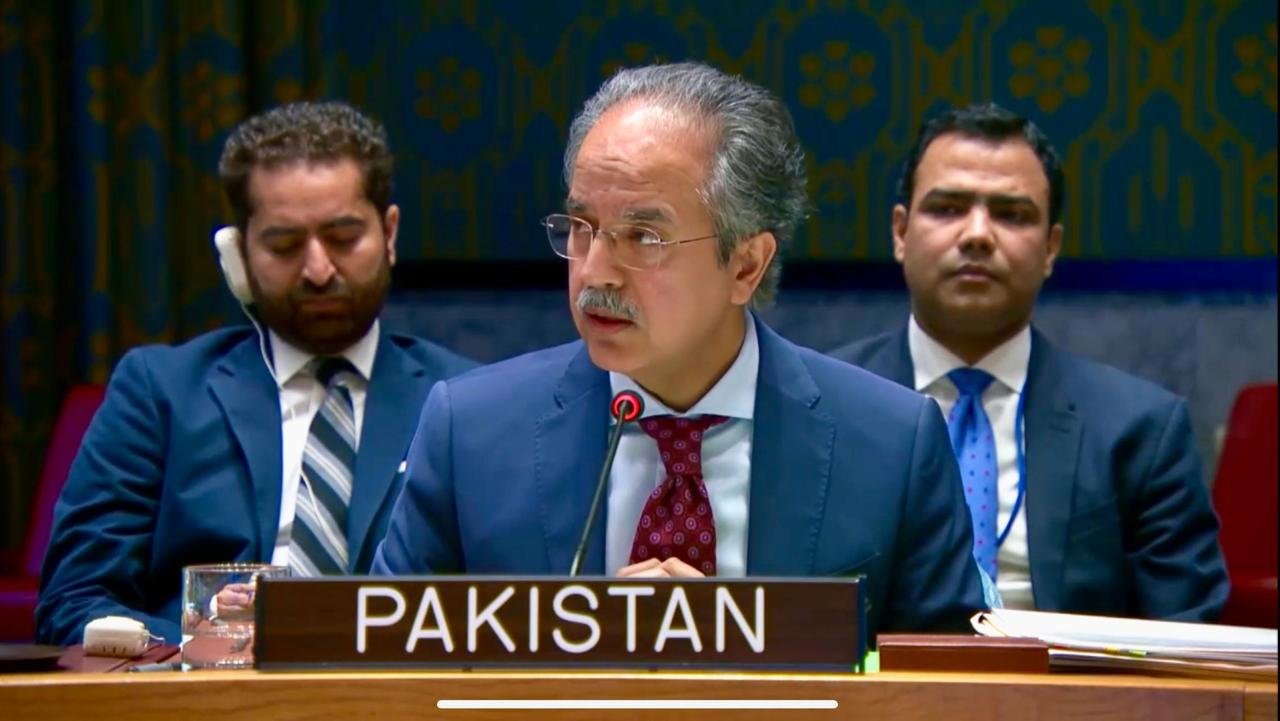
Ambassador Asim Iftikhar Ahmad, Pakistan’s Permanent Representative to the UN, highlighted Pakistan’s unparalleled sacrifices and vital contributions to global counter-terrorism at the UN Security Council briefing on ‘Enhancing Regional Counter-Terrorism Cooperation in West Africa and the Sahel’.
He noted that Pakistan, as a frontline state against terrorism, has paid a heavy price — losing more than 80,000 lives and suffering billions of dollars in economic losses.
He added that Pakistan’s key role in dismantling Al-Qaeda demonstrates a level of counter-terrorism expertise that few countries possess. Yet, despite these sacrifices, Pakistan continues to face threats from terrorist groups supported by its neighbor.
“Having dismantled Al-Qaeda and its affiliates in our region, we nevertheless continue to face threats from terrorist groups such as the TTP, Daesh, BLA and the Majeed Brigade, that operate with support and sponsorship of our neighbour,” he stated.
On the regional developments in the Sahel and West Africa, the Ambassador characterized the rapidly deteriorating security environment as “deeply alarming”, pointing to the 2025 Global Terrorism Index ranking five of the ten most terrorism-affected countries in the Sahel.
Al-Qaeda and Daesh affiliates, including ISGS and JNIM, are exploiting ungoverned spaces, cross-border vulnerabilities, and illicit economies, threatening regional stability and international peace and security architecture alike, he said.
The Pakistan UN Ambassador advanced a coherent framework of priority measures to anchor a regional counter-terrorism response, beginning with the restoration of trust and collective security arrangements among West African and Sahelian States to confront cross-border terrorist networks.
He said that a multidimensional strategy must integrate calibrated kinetic operations with political inclusion, economic revitalization, and social cohesion. He further urged the reinforcement of ECOWAS, the Accra Initiative, the Nouakchott Process, and the Multinational Joint Task Force, supported by more substantive engagement with the Arab League and the OIC.
Appealing for a renewed United Nations-African Union partnership – particularly predictable financing for AU-led operations under Resolution 2719 – Ambassador Asim Iftikhar Ahmad also called for the revision of sanctions frameworks, including a broadened 1267 regime attuned to Africa’s emerging threats.
He reaffirmed that robust national capacities to confront technological and financial enablers of terrorism, together with efforts to remedy structural drivers of instability are indispensable to enduring peace.
He recalled Pakistan’s long-standing and distinguished engagement with Africa, marked by continuous peacekeeping contributions in Liberia, Côte d’Ivoire, the DRC, Mali, the Central African Republic, Sudan, South Sudan, and Sierra Leone. These deployments, he underscored, attest to Pakistan’s “deep, historic, and principled commitment to Africa’s peace and stability.”
Closing his statement, he reminded the Security Council that the people of West Africa and the Sahel “deserve a future defined by security, dignity, and development,” not the perpetuation of terrorist violence.
“This is a moment that demands unity of purpose. The cost of inaction will not be borne by one region alone, but by the entire international community.” Pakistan, he affirmed, will remain a committed partner in advancing that shared responsibility.