
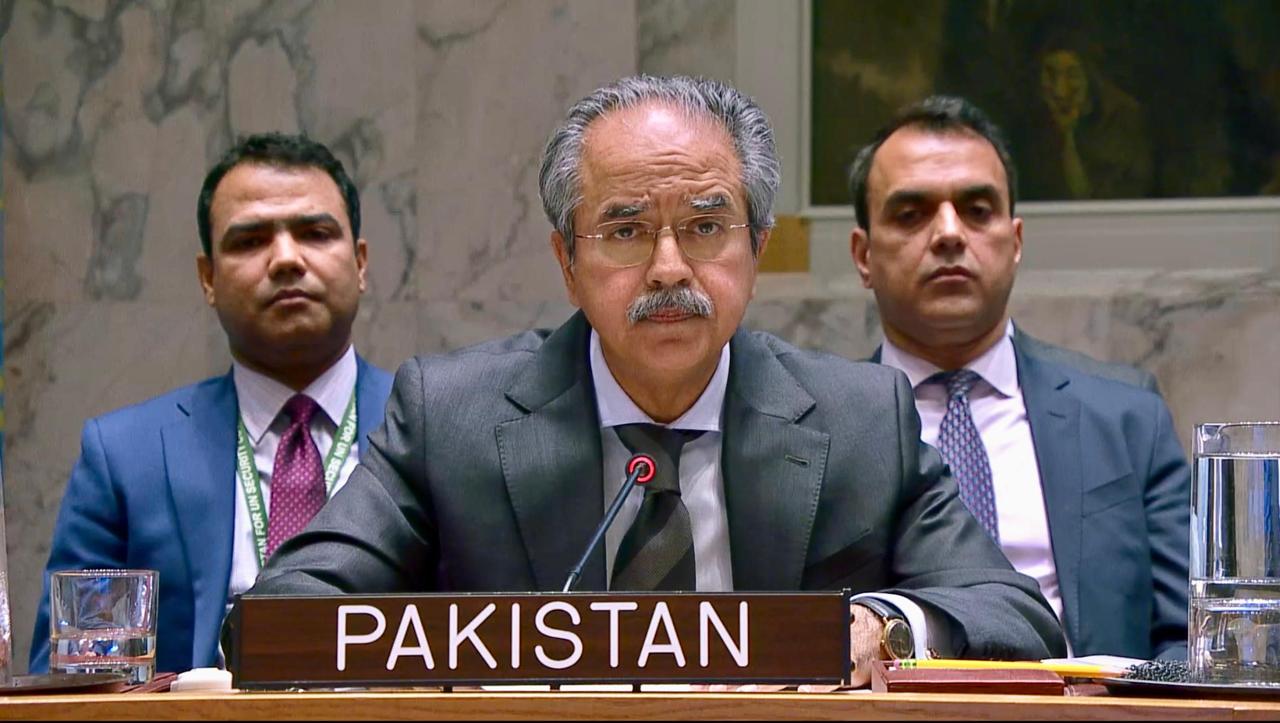

NEW YORK: Pakistan warned the UN Security Council that militant groups operating from Afghanistan are expanding their reach, and pressed the Council to confront Kabul’s failure to contain cross-border terrorism.
Speaking at Council meeting on the Situation in Afghanistan chaired by Slovenia Ambassador Asim Iftikhar Ahmad, Pakistan’s Permanent Representative to the United Nations, warned the UN Security Council that Afghanistan has again become a major launch-pad for terrorism.
He commended Slovenia’s leadership but stressed that regional stability now faces its most serious threat in years. Pakistan acknowledged briefings from senior UN officials, including Georgette Gagnon and Tom Fletcher. Officials highlighted the rising humanitarian strain and the growing gap in aid funding for 2025.
Pakistan Says Terrorism Surges After Taliban Takeover
Ambassador Asim Iftikhar Ahmad said that more than four years have passed since the Taliban seized power and ended the civil war. However, Islamabad stressed that early hopes for stability quickly faded as terrorism resurged across the region. Despite regular engagement with Taliban authorities, Pakistan stated that Afghan territory again hosts foreign and regional terrorist groups.
He emphasized that it engaged the Taliban in “good faith,” citing frequent high-level visits, humanitarian support, and trade concessions. Pakistan also participated in regional dialogues on Afghanistan’s future. Yet, according to the statement, these efforts yielded “deeply disappointing” results.
Islamabad Reports Sharp Increase in Cross-Border Attacks
Ambassador Asim Iftikhar warned that terrorist groups now operate freely inside Afghanistan, posing direct threats to the country’s security and sovereignty. Entities such as ISIL-K, Al-Qaeda, TTP, ETIM and the BLA reportedly maintain safe havens on Afghan territory.
He highlighted that the UN Monitoring Team confirms the TTP alone fields nearly 6,000 fighters in Afghanistan. Islamabad said it has intercepted multiple infiltration attempts and seized advanced military equipment left behind by foreign forces.
Despite these operations, Pakistan reported almost 1,200 deaths from Afghan-based terrorism in the past year. Authorities also neutralized more than 214 Afghan militants in counterterror operations since 2022.
Pakistan Accuses Regional Spoilers of Fueling Instability
Pakistan’s Permanent Representative claimed elements within the Taliban support these groups by granting safe passage, training space, and logistical access. It also alleged evidence of collaboration among terrorist outfits, including joint training and coordinated attacks using Afghan soil.
He further accused an unnamed regional “spoiler” of intensifying material and financial support for anti-Pakistan militants. Pakistan called on the UN Assistance Mission in Afghanistan, UNAMA, to strengthen action against illicit arms flows and the accumulation of dangerous weaponry across the region.
Pakistan Urges Taliban to Meet Counter terror Obligations
Ambassador stated that despite its deep security concerns, it continued dialogue with the Taliban, including recent talks in Doha and Istanbul. It thanked the governments of Qatar and Türkiye for facilitating discussions.
He insisted the Taliban must take verifiable action against terrorist groups. Otherwise, Islamabad will implement necessary defensive measures to protect its people and territory. It also urged UNAMA to provide objective assessments of border security incidents, stressing that such clashes stem from terrorism, not political disputes.
Women’s Rights, Sanctions, and Humanitarian Gaps Add Pressure
Pakistani Envoy accused the Taliban of worsening Afghanistan’s political and economic collapse. Sanctions, aid shortages, poverty, narcotics production, and sweeping restrictions on women have deepened the crisis. Islamabad said these policies contradict Islamic values recognized by the Organization of Islamic Cooperation.
UN officials reported alarming humanitarian trends, including significant financing gaps in the 2025 Humanitarian Needs and Response Plan. Pakistan argued that declining aid reflects the world’s frustration with the Taliban’s unfulfilled commitments.
Pakistan Calls for Responsible Refugee Returns and Global Burden Sharing
Ambassador Asim said for over forty years, Pakistan hosted millions of Afghan refugees with limited international support. Islamabad stressed these stays were never meant to be indefinite, especially with the war now over. Pakistan expects returns to proceed in a phased and dignified manner, while urging the world to share the financial and logistical burden.
He highlighted that it maintains a liberal visa regime for Afghans. Since September 2023, it issued more than 536,000 medical visas alone.
Islamabad Supports UN-Led Roadmap for Stability
Pakistan reaffirmed its long-standing call for sustained global engagement with Afghanistan. It welcomed the next phase of the UN-led Doha Process and emphasized that the proposed Mosaic approach must address Afghanistan’s security, humanitarian, economic, and political crises comprehensively.
Ambassodor Asmim Iftikhar warned that bilateral engagements elsewhere must not be exploited by countries with hostile agendas. It urged the Taliban to stop denying security realities and to create a conducive environment for meaningful dialogue.
Pakistan Says Stability in Afghanistan Remains Core National Interest
Permanent Representative of Pakistan concluded that no country desires peace in Afghanistan more than its own. Geography, culture, religion, and shared history bind both nations. Pakistan said it has also suffered the most from decades of Afghan conflict. Despite ongoing threats, Islamabad pledged continued efforts to support a peaceful, stable, and prosperous Afghanistan.
Comments are closed.