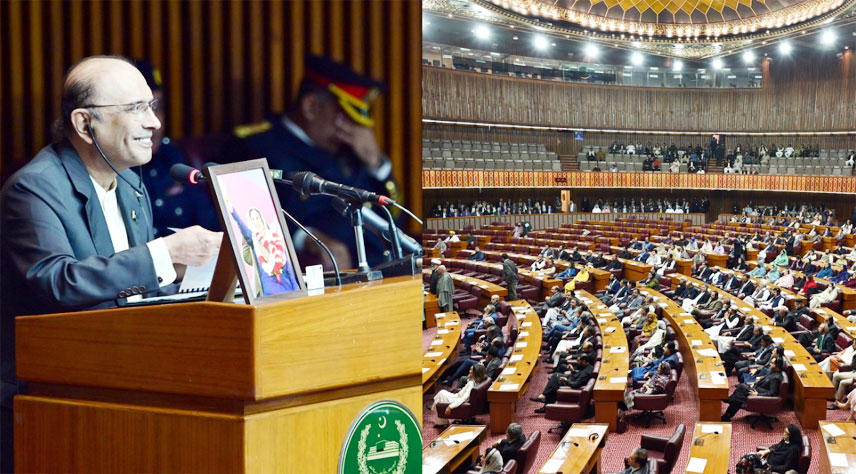
ISLAMABAD: President Asif Ali Zardari while addressing the joint session of parliament reaffirmed Pakistan's commitment to safeguarding its sovereignty, regional stability, and economic growth.
His speech, delivered on Monday, covered a range of critical issues, including Afghanistan’s role in harboring terrorist groups, Pakistan's stance on Kashmir, and the country's foreign relations.
Beginning with the ongoing security concerns in Afghanistan, President Zardari condemned the Afghan government for failing to dismantle terrorist networks operating on its soil, despite repeated diplomatic interventions by Pakistan and its allies. The President referred to a recent UN report, which labeled the presence of these groups as an “extra-regional threat,” warning that ignoring this issue could lead to further destabilization in the region. Zardari expressed frustration over Afghanistan’s continued provision of safe havens for groups such as Al-Qaeda, the Tehreek-e-Taliban Pakistan (TTP), and the Baloch Liberation Army (BLA).
"The Afghan government must dismantle the terror groups that thrive on conflict and war. It’s time for them to stop being a proxy for external ambitions,” Zardari said, emphasizing the need for Afghanistan to honor its commitments made during the Doha talks to prevent the use of its territory for terrorism.
The President also addressed Pakistan's support for Iran’s sovereignty amid escalating tensions in the region. He condemned attacks launched on Gulf countries, including the UAE, Bahrain, Jordan, Kuwait, Qatar, and Saudi Arabia, and offered condolences for the martyrdom of Iran’s Supreme Leader, Ayatollah Ali Khamenei.
Zardari turned to Pakistan’s internal issues, emphasizing the need for national economic stability. He stressed the importance of eliminating terrorism, enhancing job creation, and focusing on economic growth to ensure a prosperous future for Pakistan. The President also called for greater federal harmony and deeper democratic governance, particularly in resolving key issues like fiscal distribution, water management, and energy coordination.
Addressing the situation in Balochistan, Zardari assured the people of the province that their social and economic grievances would be addressed. "The people of Balochistan are integral to Pakistan's progress, and they must remain full partners in the country’s development," he stated.
On the Kashmir issue, Zardari reaffirmed Pakistan's unwavering diplomatic and moral support for the people of Jammu and Kashmir in their struggle for self-determination. He issued a stern warning to India, stating, “Any aggressor should prepare for another humiliating defeat. Make no mistake. We are ready for you.” Zardari called for meaningful dialogue to resolve the Kashmir dispute, underscoring that regional peace could only be achieved through negotiations, not war.
The President also condemned India’s suspension of the Indus Waters Treaty, calling it "hydro-terrorism" and a violation of international law. He made it clear that Pakistan would defend its water rights with unity, strength, and legal clarity.
On the international front, Zardari spoke of the growing ties between Pakistan and China, particularly through the China-Pakistan Economic Corridor (CPEC) 2.0, which he described as a transformative project for Pakistan’s infrastructure. He also highlighted strengthening relations with the Gulf countries, Azerbaijan, and Turkey, as well as the recent Pakistan-Saudi Strategic Mutual Defence Agreement.
The President concluded his address by reaffirming Pakistan’s strong support for Palestine and calling for the establishment of an independent Palestinian state, with borders as they existed before 1967 and Al-Quds Al-Sharif as its capital. He also congratulated Bangladesh on forming a new government, expressing hope for stronger bilateral relations.