
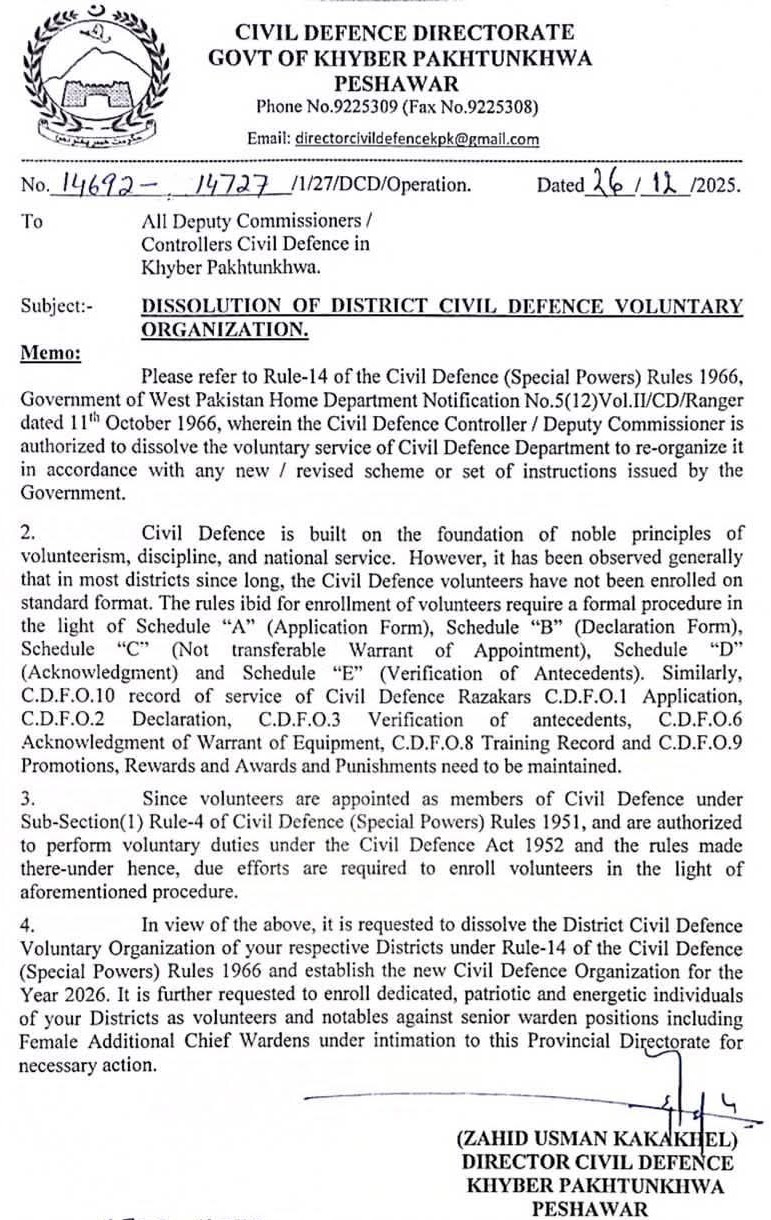

PESHAWAR: The Khyber Pakhtunkhwa Civil Defence Department has initiated concrete steps to revitalize the institution by formally dissolving the existing voluntary Civil Defence setup in all districts of the province.
According to an official notification issued by Director Civil Defence Khyber Pakhtunkhwa, Zahid Usman Kakakhel, all districts have been instructed to reconstitute a new and effective volunteer system in strict compliance with legal requirements. The new structure will comprise eligible, suitable, skilled, committed, and capable individuals.
Sources say the decision represents a practical manifestation of serious efforts to make the Civil Defence institution active, organized, and aligned with modern requirements after a long period of stagnation.
In the past, due to neglect and institutional weaknesses, Civil Defence was often viewed as an ineffective or merely symbolic organization, despite the fact that the institution carries a unique and vital national responsibility.
In peacetime, Civil Defence plays a key role in responding to natural disasters, accidents, and emergencies, while during wartime it is responsible for civilian protection and support.
Social sector experts note that the real strength of Civil Defence lies in its trained, organized, and active volunteer network. However, over the past several years, both the induction of volunteers and the effectiveness of the existing setup suffered a significant decline.
Against this backdrop, the decision by Civil Defence Khyber Pakhtunkhwa to dissolve and reconstitute the volunteer structure is being described as a bold and inevitable step.
Under the leadership of the current Director, practical measures are being taken to restore the department’s effectiveness, rebuild its credibility, and reestablish it as an active national institution.
Transparent recruitment, training, and reorganization of new volunteers are being regarded as a strong foundation for future emergency preparedness and disaster response.
Meanwhile, social, public, and welfare circles have welcomed the policy, expressing hope that all volunteer groups working on emergency response and disaster management in each district will be formally affiliated with Civil Defence.
There has also been strong emphasis on integrating non-governmental organizations (NGOs) operating at the district level with the Civil Defence Department to jointly carry out emergency and disaster management activities, ensuring a coordinated, effective, and timely response in any unforeseen situation.
According to social sector experts, if this decision is implemented effectively and consistently, Civil Defence Khyber Pakhtunkhwa could emerge as a model institution not only for the province but for the entire country in the field of civilian protection and disaster management.

Comments are closed.