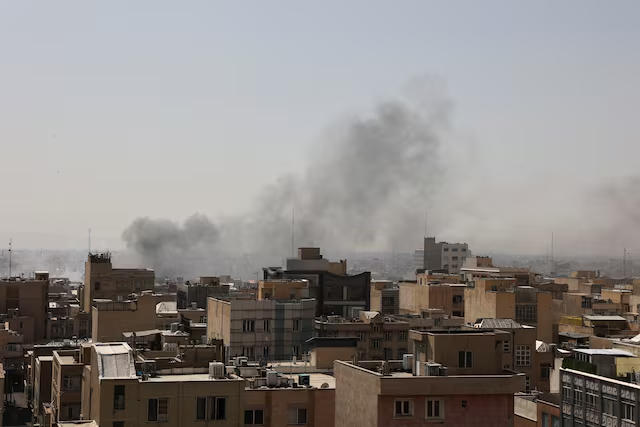
LONDON: Donald Trump has finally revealed his hand on Iran: a closed fist. After weeks of threats and escalating rhetoric, the U.S. president and Israeli Prime Minister Benjamin Netanyahu on Saturday morning authorised major air strikes targeting the country’s leaders. For both the Gulf region and the global economy the latest attacks – and Tehran’s response – create a worryingly unstable and open-ended new reality.
rump’s recent warnings had linked the possibility of an attack to ongoing negotiations aimed at restricting Iran’s nuclear capabilities. However, early on Saturday morning he laid out a wider justification for conflict based on the Islamic Republic’s 47 years of hostility towards the United States, as well as preventing it from possessing an atomic weapon. Most notably, the president called on the Iranian people to take over the government after American bombs have cleared the way. “The hour of your freedom is at hand,” he declared.
Iran’s government and armed forces have been weakened by losses sustained during last June’s 12-day war. Tehran also killed thousands of its own citizens last month following demonstrations. If the latest attacks succeed in removing Supreme Leader Ayatollah Ali Khamenei and other senior figures, it could lead to a change of leadership in Iran without embroiling American troops in another protracted conflict like the ones it fought in Afghanistan and Iraq.
Yet there is little historical precedent for air strikes by a foreign power triggering a popular uprising. It’s also far from clear that the powerful Islamic Revolutionary Guard Corps (IRGC) would accept a replacement leader, or that any new government would be less hostile to the United States. The shaky premise for the latest conflict is compounded by the fact Trump has not sought approval from Congress. Both he and Netanyahu claimed to have destroyed Iran’s nuclear programme last June, but have used the same threat as grounds to attack again.
Both sides could yet step back from a prolonged conflict, as they have in the past. However, the costs of Trump’s decision are clearer than the benefits. Iran has responded by firing missiles at Israel as well as U.S. allies in the Gulf like Bahrain, Qatar and the United Arab Emirates. Those countries’ economic plans to pivot away from fossil fuels hinge on attracting foreign direct investment and tourism. Both are bound to suffer when missile attacks force financial hubs like Abu Dhabi and Dubai to close their airspace.
The economic shocks could reverberate further if the conflict disrupts supplies of oil. Morgan Stanley reckons that if a large-scale U.S. attack is followed by significant Iranian counter-strikes, tanker disruptions in the Arabian Gulf could cut global supplies by up to 3 million barrels a day for several weeks. That would be sufficient to send crude prices soaring way above their already elevated level of $72 a barrel.
How much of this feeds through to wider global inflation, forcing central banks to keep interest rates higher for longer, depends on whether Saudi Arabia can deploy some of its 2 million daily barrels of spare oil capacity. It also hinges on how long the conflict drags on, given the risk of other disruptions like renewed attacks on Red Sea shipping by Iran-aligned Houthi forces. Whatever the outcome, Trump’s latest attacks have opened up big new risks.
Context News
- The United States and Israel launched strikes on Iran on February 28, which President Donald Trump said would end a security threat to the United States and give Iranians a chance to topple their rulers.
- The first wave of strikes in what the Pentagon named “OPERATION EPIC FURY” mainly targeted Iranian officials, a source familiar with the matter told Reuters.
- An Israeli official said Iran’s Supreme leader, Ayatollah Ali Khamenei, and President Masoud Pezeshkian were both targeted but the result of the strikes was not clear. A source with knowledge of the matter had earlier told Reuters that Khamenei was not in Tehran and had been transferred to a secure location.
- Iran’s Revolutionary Guards said a first wave of retaliatory Iranian missile and drone attacks had been launched against Israel and that all U.S. bases and interests in the region were within Iran’s reach, an Iranian official told Reuters.
- At least half a dozen witnesses, including Reuters correspondents, heard loud booms in various parts of the United Arab Emirates capital Abu Dhabi, a major oil producer and close U.S. ally. Fellow Gulf Arab state Qatar said it had downed all missiles targeting the country, the state news agency reported. Global airlines cancelled flights across the Middle East.
- In a video message published on social media, Trump cited Washington’s decades-long dispute with Iran and urged Iranians to stay sheltered because “bombs will be dropping everywhere”. But he also added: “When we are finished, take over your government. It will be yours to take. This will be probably your only chance for generations.”
- Iran was preparing a crushing retaliation, an Iranian official told Reuters.
- Israeli Prime Minister Benjamin Netanyahu said the joint U.S.-Israeli attack on Iran “will create the conditions for the brave Iranian people to take their destiny into their own hands.”--Reuters