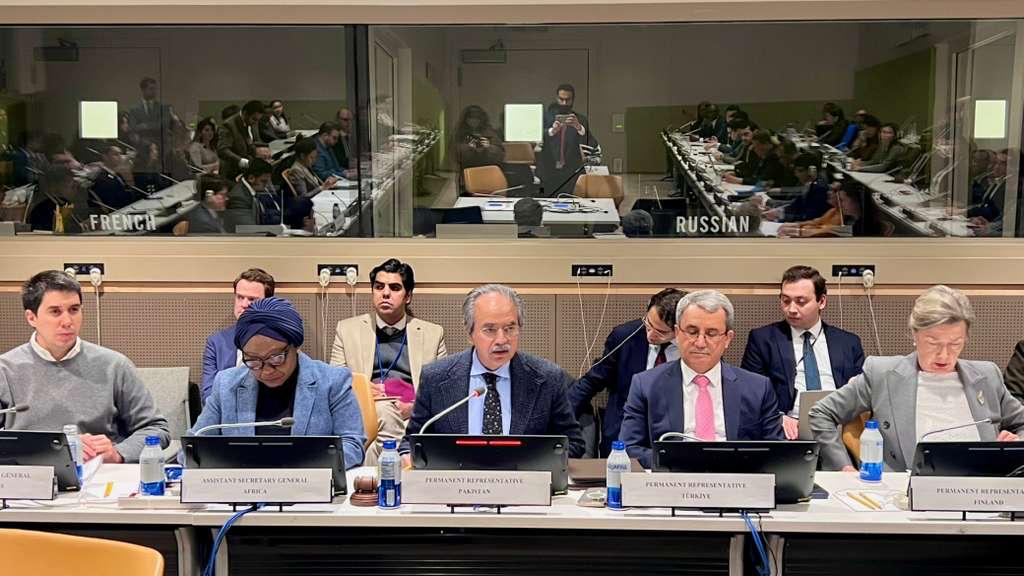
NEW YORK: Speakers at a discussion here reaffirmed the enduring relevance of the UN Charter, describing it as a cornerstone of international peace and security, particularly its provisions on the peaceful settlement of disputes under Chapter VI.
The high-level discussion titled “The UN Charter at 80: Conflict Prevention and Resolution” hosted by the Permanent Mission of Pakistan in collaboration with Global Peace Chain, a nonprofit peace-building and youth empowerment organization.
Building on the guidance of Resolution 2788 (2025) and the commitments made under the Pact for the Future, the speakers including permanent representatives/ambassadors of different UN Missions, academics and civil society representatives stated that preventive diplomacy and mediation were cost-effective and credible tools for conflict prevention.
They also advocated the meaningful engagement of youth, women, and civil society as important partners in shaping peace and security, consistent with the inclusive vision of the Pact for the Future.
The event, held at the UN headquarters, drew heavy attendance from people belonging to different walks of life, including diplomats from different UN Missions, as well as youth, women, and civil society representatives.
In addition to Ambassador Asim Iftikhar Ahmad, Permanent Representative of Pakistan to the UN, who delivered opening and closing remarks, speakers included Ms. Martha Ama Akyaa Pobee, Assistant Secretary-General for Africa; Dr. Felipe Paullier, Assistant Secretary-General for Youth Affairs; Ambassador Ahmet Yıldız, Permanent Representative of Turkiye; Ambassador Elina Kalkku, Permanent Representative of Finland; Ms. Elyse Mosquini, Permanent Observer, ICRC; and Ms. Jonah Harris, Policy Analyst, Peace, Climate and Sustainable Development Program, IPI.
The ambassadors/permanent representatives of Austria, Azerbaijan, China, Cambodia, Egypt, Cuba, Slovenia, Cuba, Timor Leste, as well as distinguished delegates from Qatar, Indonesia, Venezuela, and Russia also expressed their views on the occasion. Ms. Saima Saleem, Counsellor at the Pakistan Mission, moderated the event, while Kamran Zafar, CEO of Global Peace Chain, delivered a vote of thanks.
In his opening remarks, Ambassador Asim Iftikhar Ahmad described the 80th anniversary of the UN Charter as a moment demanding honest reflection and renewed resolve. He said that at a time when conflicts are multiplying, trust among nations is eroding, and adherence to international law is increasingly selective.
“The central question before us is not whether the Charter remains relevant — but whether we are prepared to apply it with the consistency, courage, and political will it requires,” he said.
The Pakistan UN Ambassador said that the credibility of the UN Charter is ultimately tested in its application to long-standing disputes — particularly where political sensitivities are high, but legal and moral clarity is unmistakable.
He cited the situations of Palestine and Jammu and Kashmir as among the starkest examples, stating that the Jammu and Kashmir dispute could have been a successful example of the application of Charter provisions for pacific settlement of disputes.
He said that the Security Council acted effectively in the late 1940s and early 1950s by providing the relevant framework for peacefully resolving the dispute, including provisions for self-determination, but that these remain unimplemented to this day.
He further said that reimagining conflict prevention and dispute resolution is not a call to rewrite or reinterpret the Charter, emphasizing that its wisdom has endured over the past eight decades.
“What must be reimagined is how we apply it in practice, and how we operationalize its tools — early, impartially and effectively — in a complex and rapidly evolving world,” he said.
Referring to Security Council Resolution 2788 adopted by consensus during Pakistan’s presidency of the Council in July 2025, Ambassador Asim said the resolution represents a collective decision to recalibrate the UN’s approach to peace and security by restoring the peaceful settlement of disputes to the center of the Charter framework.
He said the resolution reinforces dialogue, negotiation, mediation, and other Chapter VI mechanisms, while underscoring the responsibility of the Security Council to use these tools early to prevent disputes from escalating.
He stressed that peace cannot be selective and justice cannot be deferred indefinitely, arguing that the authority of the Charter rests on its consistent and impartial application.
“Let us reimagine conflict prevention and resolution by applying the Charter as it was intended — faithfully, courageously, and without exception,” he said.
The opening remarks were followed by a panel discussion in which speakers reaffirmed the centrality of the UN Charter as the sole framework for sustainable peace, while highlighting innovative approaches to conflict resolution. These included lessons from peacekeeping and peace-building, regional cooperation, and emerging tools such as digital diplomacy, community mediation, and artificial intelligence for early warning. They also assessed evolving threats to global stability, including cyber warfare, terrorism, disinformation, and climate-related security risks.
Ambassador Ahmet Yıldız of Turkiye stressed that enduring conflicts require renewed commitment to multilateralism and the UN Charter, noting that preventive tools under Chapter VI remain underused and under-resourced. He highlighted the Pact for the Future and Resolution 2788 as steps toward revitalizing preventive diplomacy and emphasized mediation as a professional and inclusive discipline.
Ambassador Elina Kalkku of Finland warned that the UN’s credibility depends on concrete action rather than new documents, urging stronger political will, greater Security Council engagement, and better use of existing tools for prevention and mediation.
Assistant Secretary-General Martha Ama Akyaa Pobee emphasized that shifting geopolitical dynamics have increased protracted conflicts, making prevention and mediation more critical, and described the Pact for the Future as a reaffirmation of peaceful conflict resolution.
Assistant Secretary-General Felipe Paullier stressed that young people are not disengaged but frustrated with unresponsive systems, calling for more inclusive and accountable multilateralism and genuine engagement with youth.
Ms. Elyse Mosquini of the ICRC highlighted the importance of international humanitarian law in protecting human dignity and sustaining pathways to peace, warning that erosion of these rules undermines peaceful solutions.
Mr. Jonah Harris of the International Peace Institute emphasized partnerships between the UN, regional organizations, and civil society, noting that local actors bring essential legitimacy and expertise and require sustained support.
Ambassadors and representatives from Austria, Azerbaijan, China, Cambodia, Egypt, Timor Leste, Cuba, Slovenia, Qatar, Indonesia, Venezuela, and Russia reaffirmed that the UN Charter remains the foundation for conflict prevention and peaceful dispute settlement, stressing international law, preventive diplomacy, inclusive approaches, and early warning mechanisms.
In his concluding remarks, Ambassador Asim Iftikhar Ahmad highlighted strong participation and noted the doubling of global conflicts over the past 15 years. He reaffirmed the relevance of the UN Charter, stressed the importance of consistent application of Chapter VI tools, warned against selective application of international law, and called for inclusive peace efforts involving civil society, youth, and women.
He emphasized that innovation anchored in international law can strengthen prevention, but that the main challenge remains translating commitments into concrete action.
In his vote of thanks, Kamran Zafar thanked panelists, delegates, and participants for their contributions, noting that the discussion reinforced the importance of conflict prevention, dialogue, and inclusive peace.
Participants also posed questions to the panelists on peace and security, the future of multilateralism, and the role of mediation and preventive diplomacy.