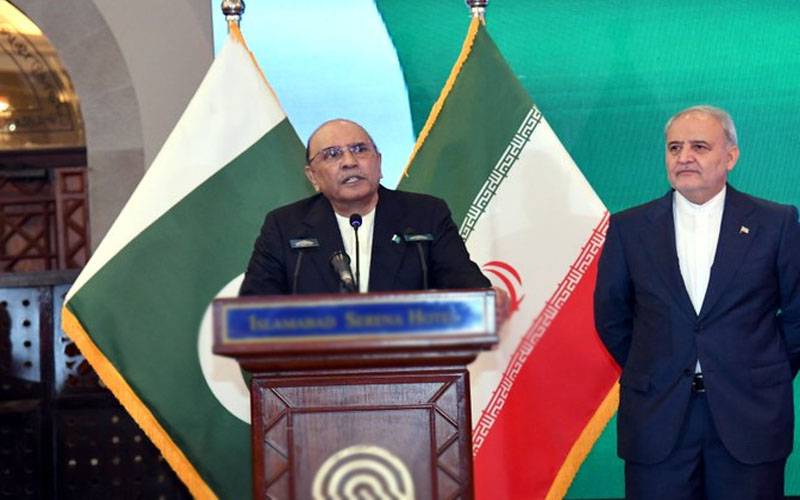
ISLAMABAD: President Asif Ali Zardari has said that Pakistan and Iran are not only neighboring countries but also “civilizational partners,” reaffirming Pakistan’s commitment to strengthening bilateral cooperation and promoting regional peace.
He expressed these views while addressing a reception hosted by the Iranian Embassy in Islamabad on the occasion of Iran’s National Day. The event was attended by federal ministers, the governors of Khyber Pakhtunkhwa and Gilgit-Baltistan, foreign diplomats, parliamentarians, prominent personalities from various sectors, and members of the media.
President Zardari said it was an honor to join the Iranian people in celebrating their national day on behalf of the government and people of Pakistan. He emphasized that the two countries share centuries-old ties rooted in faith, history, and enduring cultural bonds, reflected in their shared border and long-standing relationship of mutual respect and coexistence.
Highlighting cultural connections, the President noted the deep influence of the Persian language and its rich literary tradition on Pakistan’s intellectual and cultural life. He pointed out that Persian remained the official language in regions that now form Pakistan for centuries and continues to shape the country’s national consciousness, including its national anthem.
He also referenced renowned Persian poets such as Rumi, Hafiz, Saadi, and Ferdowsi, who are widely respected in Pakistan. He noted that Allama Muhammad Iqbal, who wrote much of his work in Persian, remains a shared symbol of pride for both nations. He also mentioned 18th-century Sindhi poet Sachal Sarmast as an example of the deep historical literary connection.
Addressing regional and global challenges, President Zardari said the region stands at a sensitive crossroads, facing ongoing conflicts, terrorism, foreign interference, and unresolved flashpoints.
He added that such challenges cannot be addressed through force or unilateral actions, warning that escalating tensions only deepen mistrust and increase human and economic losses.
Referring to Iran, he cautioned that any instability or attempts to resolve issues through military means would carry serious risks, potentially destabilizing the Gulf, South Asia, and West Asia, and harming global peace and the world economy.