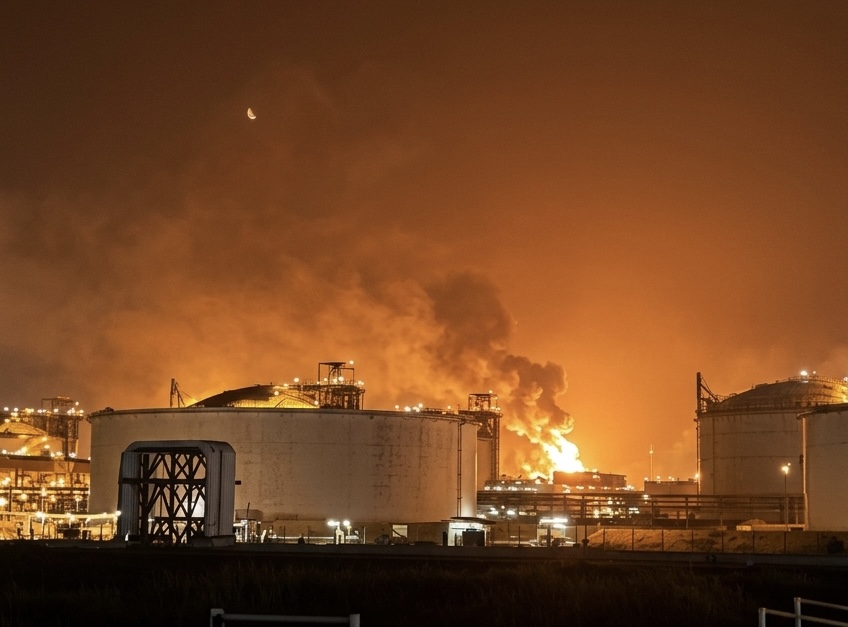
DOHA: At least 13 people were killed and 66 others injured after a powerful explosion struck Qatar’s Ras Laffan liquefied natural gas (LNG) complex, authorities said on Monday.
The blast occurred at the Barzan gas processing facility inside the vast Ras Laffan industrial city while workers were restarting operations following months of shutdown.
Qatar’s Energy Minister Saad al-Kaabi said a technical malfunction caused the explosion. He ruled out sabotage or any hostile action.
Officials said the incident did not trigger any gas leak or environmental threat. Moreover, authorities confirmed that Qatar’s LNG export operations remain unaffected.
The explosion marks one of the deadliest industrial accidents in Qatar’s energy sector in more than two decades.
Blast Occurred During Plant Restart
The Barzan facility had resumed operations only two days earlier after remaining offline since December 2025 for maintenance and conflict-related disruptions.
According to officials, workers were carrying out restart procedures when the explosion occurred. Several of those killed and injured were foreign workers, including nationals from Pakistan and India.
Meanwhile, emergency teams quickly reached the site and brought the fire under control. Authorities also evacuated affected sections of the complex as a precaution.
QatarEnergy has launched a full investigation to determine the exact cause of the explosion.
LNG Exports Continue Despite Tragedy
Although the blast damaged parts of the Barzan facility, Qatar said LNG production and exports would continue without interruption.
The Ras Laffan industrial city serves as the backbone of Qatar’s energy industry and houses some of the world’s largest LNG processing facilities.
Furthermore, the accident comes as Qatar seeks to restore full operations after regional conflict disrupted energy infrastructure earlier this year.
Energy analysts warned that while exports remain stable, the explosion highlights ongoing vulnerabilities in Gulf energy infrastructure during a period of regional instability.
Qatar remains the world’s largest exporter of liquefied natural gas, making any disruption at Ras Laffan closely watched by global energy markets.