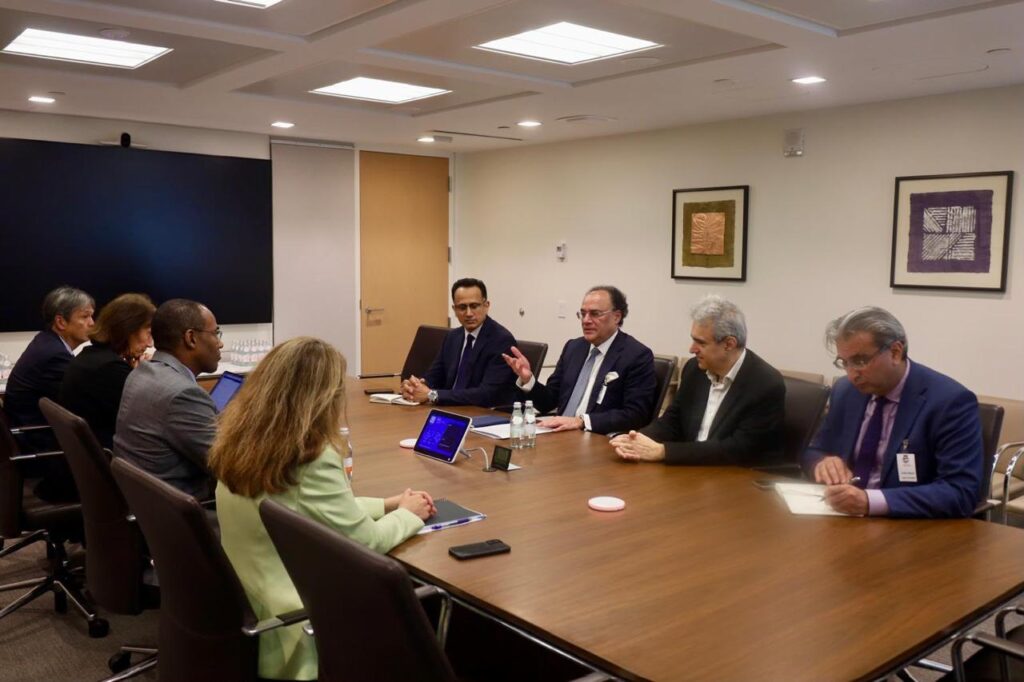
WASHINGTON: Finance Minister Senator Muhammad Aurangzeb held a series of meetings with senior International Monetary Fund (IMF) officials to review Pakistan’s macroeconomic performance and progress under the Extended Fund Facility (EFF), the Resilience and Sustainability Facility (RSF) and the broader IMF-supported reform programme.
The minister met First Deputy Managing Director Dan Katz, Deputy Managing Director Nigel Clarke, Director of the IMF’s Middle East and Central Asia Department Jihad Azour, and Pakistan Mission Chief Iva Petrova.
According to the Finance Division, the discussions focused on Pakistan’s improving fiscal and external balances, achievement of revenue targets, higher foreign exchange reserves, record remittances and an improved current account position.
The two sides also reviewed progress on tax and energy sector reforms, privatisation, tariff rationalisation, debt management, diversification of financing sources and Pakistan’s planned return to international capital markets.
The meetings also covered human capital development, women’s economic participation, demographic challenges, technology-led growth and private sector-led, export-oriented development.
The finance minister thanked the IMF for recognising Pakistan’s strong ownership of the reform programme and progress on structural reforms.
He reaffirmed the government’s commitment to fiscal discipline, policy credibility, structural reforms and long-term economic transformation.
Meeting with President and Chairman U.S. EXIM Bank
The finance minister also met with U.S. EXIM President and Chairman, John Jovanovic.
Discussed expanding Pakistan–U.S. economic and commercial cooperation with a focus on financing for specific long-term projects, and increased trade in agricultural commodities, including cotton and soybeans and hydrocarbons.
Welcomed the U.S. EXIM proposal of developing a broader framework to consolidate priority projects, establish a multi-year transaction pipeline, and facilitate U.S. financing, technology, equipment, and services.
Both sides agreed to identify near-term transactions, designate focal persons, and work towards finalizing the strategic framework, with a view to having it signed on the sidelines of UN General Assembly session in September 2026.