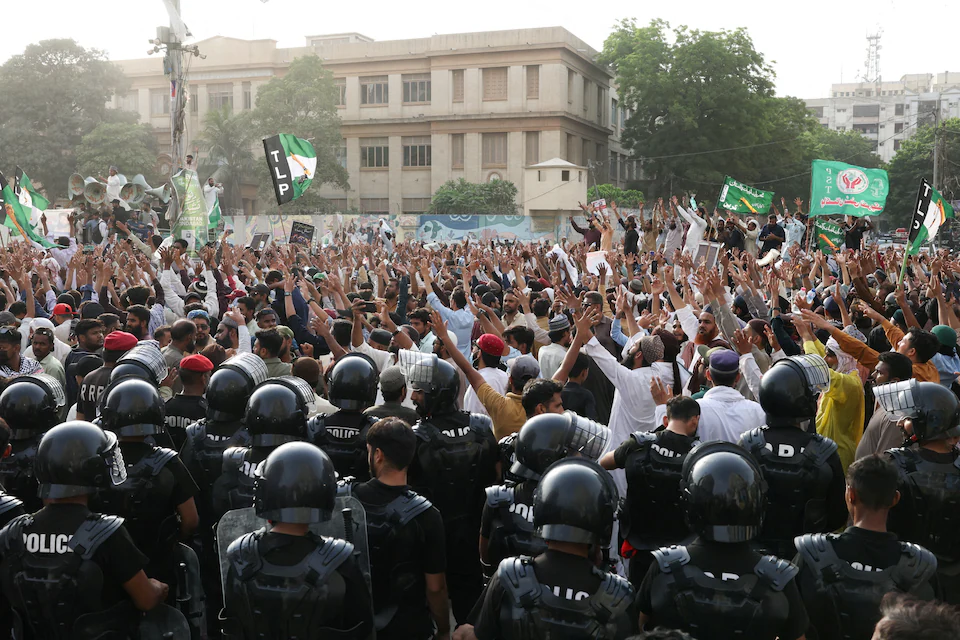
ISLAMABAD/KARACHI: When blasphemy allegations against a Christian family prompted a mob of hundreds to assemble in Pakistan’s teeming metropolis Karachi last month, officers knew they might only have minutes to save the four women and one child who were targeted.
Islamic Pakistan has witnessed around 90 blasphemy-linked lynchings since 1990 and many started exactly like this.
But as police officer Sanghaar Ali Malik and his unit confronted the crowd on a narrow street, Malik recalled he sensed a chance to end the situation peacefully.
The deafening chant of “Death to blasphemers!” was in the air, but the main instigators of such riots in the past — Pakistan’s powerful fundamentalist groups — were missing, reflecting a military-led crackdown that has cut registered blasphemy cases by roughly two-thirds this year.
“No religion allows you to take the law into your own hands,” Malik said he told the crowd, quoting verses from the Muslim holy book, the Koran.
Surprisingly, even for himself, Malik said in an interview, the people listened. With no instigators whipping up frenzy, they melted away after being assured that police would investigate the case.
The country’s Islamist groups have long been backed by the powerful military to keep the civilian government in check, and, occasionally, to stoke tensions with hostile nations, analysts say. But the groups have retreated to the shadows after a crackdown that four government and security sources said was overseen by army chief Field Marshal Asim Munir.
The crackdown, the sources and analysts said, was driven by Pakistan’s desire to improve ties and better integrate its economy with the West, as Munir builds on a personal rapport with U.S. President Donald Trump. It comes after Islamabad’s falling out with the Afghan Taliban, an erstwhile ally that also hands out custodial and corporal punishments for blasphemy.
The reasons for the crackdown have not been previously reported in detail.
One of the sources, who is close to Munir’s inner circle, said the military chief was “clear that these Islamist groups and a progressing Pakistan cannot go together.”
Munir, the source added, was personally involved in ensuring zero tolerance for the fundamentalist groups as he seeks to portray nuclear-armed Pakistan in a positive light.
Pakistan’s military did not respond to a request for comment.
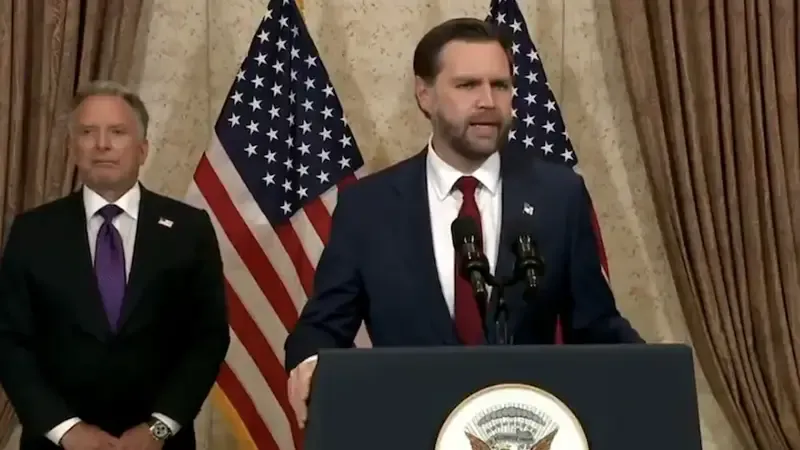
“The state has learned lessons from past experiences,” Talal Chaudhry, minister of state for the interior, told Reuters, referring to the crackdown. “The government and the army are on one page…there has never been this much clarity. That is to crush any group that tries to hold the people or this country hostage to its dictates.”
In one of the most visible effects of the crackdown, the number of registered blasphemy cases has dropped to 13 so far this year, down roughly two-thirds against comparable periods in recent years, according to the Human Rights Commission of Pakistan, an independent body.
While Pakistan saw over seven blasphemy riots or attacks per year between 2021 and 2024 on average, there was only one over the past 12 months, according to separate data provided to Reuters by Armed Conflict Location and Event Data, a conflict monitoring site.
THE SON OF AN IMAM
Munir, the latest in a long line of generals who have dominated Pakistani politics, has been at the forefront of revamping the country’s image, burnishing ties with the U.S., China and Saudi Arabia.
But domestically he faces challenges from crippling insurgencies that feed upon the Islamists, and a shattered economy.
Munir is the son of an imam and a deeply conservative Muslim himself, and theology remains ingrained in Pakistan’s state apparatus. Yet he is seeking global recognition and support through crypto deals, foreign funds, mediating in the U.S.-Iran conflict and signing a mutual defence deal with Saudi Arabia.
In the summer of 2025, Pakistani officials became increasingly worried that the fundamentalists’ hostility towards France and other European nations was endangering an EU duty waiver for Pakistani products, said two Pakistani government sources.
Almost one-third of Pakistan’s exports go to the EU and a sudden drop could have thrown its economy into turmoil.
The European Commission and Pakistan’s commerce ministry did not respond to requests for comment.
The Trump administration has also made alleged persecution of Christians an issue. The government’s religious watchdog, the U.S. Commission on International Religious Freedom, recommended last year that Pakistan be re-designated as a Country of Particular Concern because of its blasphemy laws. Pakistan has rejected the designation.
Abdul Basit, an analyst at Singapore’s S. Rajaratnam School of International Studies, said worsening insurgencies in the country’s two most mineral-rich regions of Balochistan and Khyber Pakhtunkhwa had likely contributed to a sense of urgency for Munir, who had pitched investments in the minerals sector to the U.S. government last year.
“Religious groups have fallen out of favour,” he said.
While the militias behind these insurgencies are not directly linked to the newly banned Islamist groups, they’ve traditionally relied on the same pool of young, radicalised men.
“The question will be whether Pakistan is able and willing to maintain this focus,” said Elizabeth Threlkeld, director of the Stimson Center’s South Asia program.
THREAT’ TO PAKISTAN
The largest fundamentalist group, Tehreek-e-Labbaik Pakistan, or TLP, which used “Death to blasphemers!” as its rallying cry, was banned late last year. Many of its leaders were sent to jail, its mosques sealed and its bank accounts frozen.
A previously unreported government document that paved the way for the ban argued that the group had “turned into a serious threat to Pakistan” by not only harming “internal peace” but also “the country’s reputation at the international level.”
A TLP spokesperson referred to a statement the group released last year, which called the ban illegal and unconstitutional.
The government cracked down earlier on other Islamist groups like Lashkar-e-Taiba and Jaish-e-Muhammad after pressure from the Financial Action Task Force, a global watchdog against terror financing.
Basit attributed the latest crackdown to soul-searching within Pakistan over its past support for the Afghan Taliban. Islamabad now accuses the Taliban, in power in neighbouring Afghanistan, of fuelling widening Islamist insurgencies against the Pakistani state.
The Afghan Taliban called the accusation “baseless.”
A spokesman for its foreign ministry declined comment on the crackdown on the TLP, calling it an internal affair of Pakistan.
For Pakistan’s Christian, Shi’ite and Ahmadi minority groups, the shift has been stunning.
Suspects in blasphemy killings — including police officers — were at times showered with rose petals or given red carpet receptions. Many people accused of setting Christian churches or minority Muslim mosques on fire have been publicly lauded.
Blasphemy, still punishable by death under Pakistani law, has long been so sensitive that even a suspicion could lead to riots and lynchings. Victims’ families have rarely seen justice delivered, human rights groups say, because judges and lawyers were too afraid to take up their cases.
The police officer Malik said he and everyone else who confronted the crowd in Karachi last month felt “fear in their hearts.”
The Christian family that was targeted was eventually brought to safety, and an initial inquiry has since found the allegations against them to have been false, Malik said.–Reuters