Dr. Ghulam Nabi Fai
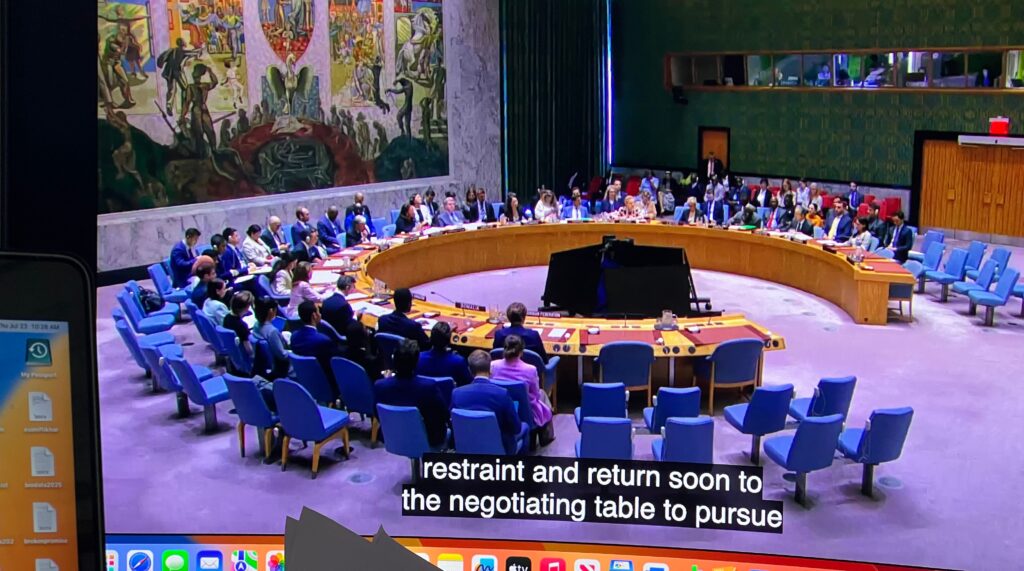
The United Nations Security Council’s high-level debate on July 23, 2026, on “Strengthening the Mechanism for the Peaceful Settlement of Disputes” served as a timely reminder that diplomacy remains humanity’s most effective instrument for preventing war. Convened as a follow-up to Security Council Resolution 2788 (2025), unanimously adopted during Pakistan’s presidency of the Council in July 2025, the meeting brought together more than six dozen delegations under the presidency of Her Excellency Thérèse Kayikwamba Wagner, Foreign Minister of the Democratic Republic of the Congo.
The discussion could not have come at a more critical moment. Around the world, conflicts are increasing in number, duration and complexity. International law is under unprecedented strain, and faith in multilateral diplomacy is being tested.
UN Secretary-General António Guterres captured this reality with remarkable clarity. He warned that today’s conflicts are marked by “an alarming disregard for international law,” emphasizing that every violation left unanswered becomes a precedent for the next. He reminded Member States that Resolution 2788 calls upon them to make full use of the peaceful settlement mechanisms enshrined in the UN Charter and reaffirmed the Security Council’s responsibility under Chapter VI. Equally encouraging was his commitment to continue employing his good offices in support of mediation and preventive diplomacy.
President of the Security Council for the month, Foreign Minister Thérèse Kayikwamba Wagner, reinforced the same message. She observed that peaceful settlement is not an abstract aspiration but one of the foundational principles of the UN Charter. Her emphasis on early warning, preventive diplomacy, mediation and dialogue underscored a truth often forgotten in international politics: diplomacy delayed is frequently diplomacy denied.
Pakistan’s Permanent Representative to the United Nations, Ambassador Asim Iftikhar Ahmad, rightly emphasized that Resolution 2788 reaffirmed a simple yet urgent principle—that diplomacy must not become the instrument the international community reaches for only after peace has already collapsed. He welcomed the Secretary-General’s recommendations and stressed that their implementation would strengthen not only mechanisms for peaceful dispute settlement but also the credibility of the UN Charter itself.
Ambassador Asim Iftekhar added that principles of Pakistan’s foreign policy and diplomatic practice reflect its firm belief in the pacific settlement of disputes. On the core issue bedeviling peace and stability in South Asia – the longstanding Jammu and Kashmir dispute – Pakistan remains committed to a peaceful settlement in accordance with the numerous resolutions of the Security Council that affirmed the principle of self-determination of the Kashmiri people and provided that the final disposition of the State of Jammu & Kashmir will be decided through the democratic method of a free and impartial plebiscite to be conducted under the auspices of the United Nations.
Delegations from China, the United States, Latvia, Türkiye, Indonesia and many other Member States echoed similar themes. They called for respect for international law, stronger preventive diplomacy, effective mediation and renewed political commitment to peaceful conflict resolution. A clear consensus emerged: the principles of the Charter must be applied consistently and without selectivity.
That consensus inevitably raises a fundamental question. If the international community sincerely believes in the peaceful settlement of disputes, can it continue to ignore one of the world’s oldest unresolved items on the Security Council’s agenda?
The Jammu and Kashmir dispute has remained before the United Nations for more than seven decades. More than sixteen substantive Security Council resolutions recognize the principle of self-determination and envisage the final disposition of the territory through a free and impartial plebiscite under UN auspices. Whether one agrees with Pakistan’s legal and political position or India’s position, it cannot be denied that Kashmir has remained an unresolved dispute with continuing implications for regional and international peace.
India’s Permanent Representative, Ambassador Parvathaneni Harish argued that the Security Council should not continue considering “decades-old issues” under “outdated and irrelevant mandates.” He further reiterated same old India’s stance that Jammu and Kashmir is an integral part of India.
Yet the mere passage of time cannot invalidate solemn international commitments. If age alone rendered international obligations obsolete, countless treaties and foundational principles of international law would lose their force. The UN Charter itself would become vulnerable to the same argument. International obligations do not expire simply because they remain unimplemented; rather, they continue to bind until fulfilled or lawfully superseded.
History demonstrates why this matters. India and Pakistan remain nuclear-armed neighbors whose relations have repeatedly approached dangerous levels of escalation. The April 2025 Pahalgam attack and the subsequent crisis illustrated how rapidly events can move toward confrontation before diplomacy intervenes. Credit goes to President Donald J. Trump whose timely intervention brokered the ceasefire and save the region from nuclear catastrophe. Any future miscalculation between two nuclear powers would carry consequences extending far beyond South Asia.
This concern has long been shared by respected international leaders and scholars. Former Japanese Deputy Prime Minister Tsutomu Hata warned that peace in South Asia would remain threatened unless Kashmir was addressed.
Former World Bank President James Wolfensohn similarly argued that lasting peace and stability required an amicable settlement of the dispute. The late Professor Stanley Wolpert described Kashmir as the most pressing unresolved legacy of the late 1940s, while President Vladimir Putin also urged India and Pakistan to resolve the issue in the interests of regional and global peace.
More recently, Praveen Donthi of the International Crisis Group observed that any durable peace process requires Kashmiris themselves to have “a chair at the table of negotiations.” Sustainable peace cannot be achieved by excluding the very people whose future remains at stake.
The central lesson from the Security Council debate is straightforward. The peaceful settlement of disputes cannot be selective. The principles of the Charter either apply equally to all international disputes or risk losing their universal legitimacy.
And as Article 2(3), Charter of the United Nations clearly states, “All Members shall settle their international disputes by peaceful means in such a manner that international peace and security, and justice, are not endangered.”
Resolution 2788 represents an important reaffirmation of preventive diplomacy, mediation and negotiated settlement. It’s true significance, however, will ultimately be measured not by eloquent speeches but by consistent implementation. The credibility of the United Nations depends on applying its principles impartially, including where the political challenges are greatest.
As Pakistan’s Counsellor at the United Nations, Saima Saleem, aptly observed, lasting peace in South Asia cannot be achieved through denial or defiance but through respecting the right of the people of Jammu and Kashmir to determine their own future. It is true that the broader principle remains beyond dispute: unresolved conflicts do not disappear with time—they demand political courage, principled diplomacy and sustained international engagement.
Finally, sincere appreciation is due to the Democratic Republic of the Congo for convening this important debate, to Secretary-General António Guterres for his principled leadership and unwavering commitment to preventive diplomacy, to Ambassador Asim Iftikhar Ahmad and the Permanent Mission of Pakistan for keeping the Security Council focused on peaceful dispute resolution, and to all Member States whose thoughtful interventions reaffirmed that dialogue, mediation and adherence to international law remain the surest path toward a more peaceful and secure world.