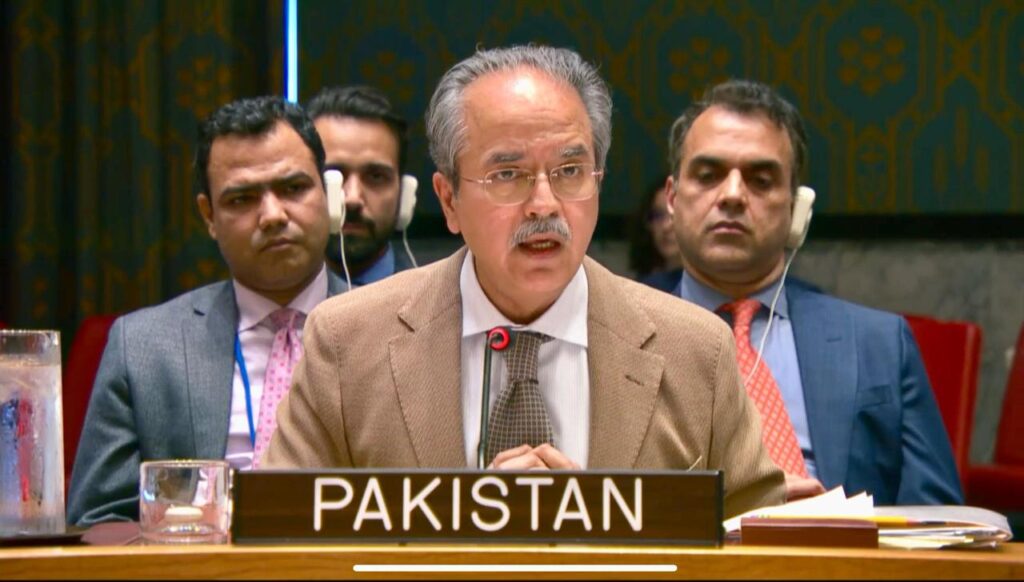
NEW YORK: Pakistan has renewed its call to reform the United Nations Security Council, warning that misuse of veto power continues to paralyze global decision-making. Speaking at the third Intergovernmental Negotiations (IGN) meeting, Ambassador Asim Iftikhar Ahmad outlined Islamabad’s firm stance against expanding veto privileges.
He aligned Pakistan with the Uniting for Consensus group, reinforcing opposition to adding new permanent members. He stressed that the Council’s repeated inaction on critical security issues stems directly from the misuse of veto power.
Moreover, he noted that this concern extends beyond diplomatic circles. Think tanks, academia, media, and civil society widely criticize the veto as outdated. He argued that expanding veto power contradicts the growing global demand for accountability.
From Handshakes to Airstrikes: The Real Story Behind U.S. Peace Deals
Pakistan, therefore, maintains a clear position. It calls either for the abolition of the veto or strict limits on its use. Expanding veto authority, he warned, would only deepen existing dysfunction.
Rising Veto Use Sparks Urgency for Reform
Despite reform discussions, the frequency of veto use has increased in recent years. This trend, Ahmad argued, demands urgent corrective measures. He emphasized that the veto primarily serves as a blocking tool, often halting critical resolutions.
Consequently, Pakistan supports initiatives that increase transparency and accountability. These include mechanisms allowing the General Assembly to review veto decisions. Such steps, he said, can raise the political cost of using veto power.
However, he acknowledged a key constraint. The five permanent members remain united in preserving their veto privileges. This reality, he noted, limits the scope of immediate structural reform.
Even so, Pakistan insists that incremental changes can still shift the balance. Strengthening oversight and public scrutiny can gradually pressure veto-wielding states.
Expanding Elected Members as a Strategic Counterbalance
Pakistan proposed a practical alternative to expanding veto powers. It advocates increasing the number of elected, non-permanent members in the Council. This, Ahmad argued, would dilute the dominance of permanent members.
He explained that a larger Council would require more affirmative votes to pass resolutions. For example, a 26-member Council could require at least 16 or more votes. This would make veto use more politically costly.
As a result, any veto would directly oppose a broader majority. This dynamic would increase accountability and reputational risks for permanent members. It would also strengthen the voice of smaller and medium-sized states.
Furthermore, Ahmad rejected claims that more elected members would not rebalance power. He described such arguments as counterintuitive and disconnected from reality.
Risks of Expanding Permanent Membership
Ahmad warned against proposals to expand permanent membership. He argued that adding more veto holders would create chaos in decision-making. A Council dominated by permanent members, he said, would struggle to function effectively.
Instead, he stressed the importance of collective decision-making. Increasing elected members would force broader consensus-building. This would reduce the ability of a few states to dominate outcomes.
Additionally, he highlighted how current dynamics favor permanent members. With only a few additional votes needed, they can often push resolutions through. Expanding elected membership would make this process more inclusive and representative.
Regional Representation as a Reform Path
Pakistan also proposed strengthening regional representation in Council decisions. Ahmad suggested requiring regional consensus for resolutions affecting specific regions. This would enhance local ownership and legitimacy.
Such a model could particularly benefit regions like Africa and the Arab world. These groups increasingly seek a stronger collective voice in global governance. Regional alignment, he argued, would raise the cost of unilateral veto use.
Moreover, this approach would shift the focus from individual power to collective responsibility. It would encourage more balanced and context-sensitive decision-making.
Call for Comprehensive and Unified Reform
Ahmad concluded by stressing that Security Council reform must remain comprehensive. He opposed addressing the veto issue in isolation or delaying it. Instead, he urged member states to treat reform as a single, unified process.
He reiterated that core principles must guide all reform efforts. These include democracy, representation, accountability, effectiveness, and transparency. The current veto system, he argued, contradicts each of these principles.
Therefore, Pakistan calls for a fundamental rethink. “If we want reform for all,” he emphasized, “there should be privilege for none.”